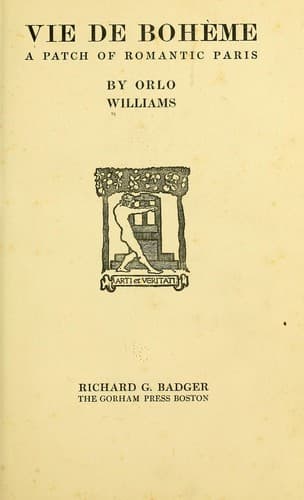
Vie de Bohème: A Patch of Romantic ParisWilliams, Orlo
History
Vie de Bohème: A Patch of Romantic Paris
Williams, Orlo
Paris (France) -- Intellectual life; Paris (France) -- Social life and customs
Champfleury says little of the amiable goddess who rescued him from
vagabondage except that she left him, like Mimi, because she grew tired
of cheap muslin, but in another chapter he gives some account of two
other idols of Bohemia whom he calls Mademoiselle M. and Mademoiselle P.
Mademoiselle M. was dark and merry, a thorough coquette who laughed at
wounded hearts; Mademoiselle P. was fair and melancholy, always in tears
for the last lover who had left her. A generation of Bohemians were
their lovers, poets and painters especially. As the generation grew up
the divinities grew wiser, and Mademoiselle M. was the first to do a
little mental arithmetic. For her own friends who had a future the days
of idleness were over; there was no future for her either among the
stranded remainder or in a new generation. Accordingly she departed to
more profitable spheres. Mademoiselle P. stayed a little longer, still
loving her poets, and weeping _toutes les larmes de son corps_ to find
that she had a too formidable rival in the desire for fame which watched
at the door of her lovers' hearts, till finally she found a worthy man
who was no poet to love her and eventually to marry her. Mademoiselle
M., meanwhile, had made by her conquests quite a respectable capital,
with which one fine day she set sail for Algiers. Unhappily she left
Marseilles in a steamer which sank with all hands, so that she and her
gold came to rest at the bottom of the sea--a sad story from which
Champfleury in an unworthy moment makes some show of drawing a moral.
Neither of these young women can be identified with Murger's heroines.
Musette, as I have said, married a chemist; Phémie Teinturière,
Schaunard's choice, was according to Delvau, a not over-respectable
person resembling a heroine of Paul de Kock; as for Mimi, Delvau
asserts that Murger loved her while he wrote the "Scènes de la Vie de
Bohème," and that her life and wretched death are matters of fact.
However, that we may not be too lugubrious let me add that I have read
in the French equivalent of "Notes and Queries" a statement that she
cheerfully lived to keep a stall in the market.
Public-domain text, read in full here on John Shaqi.
Reviews
Reviews
No reviews yet
Be the first to share your thoughts on this work.
Elsewhere in the archive
Join the Discussion
Join the discussion
Sign in to leave a comment or review.
Sign InorCreate an account