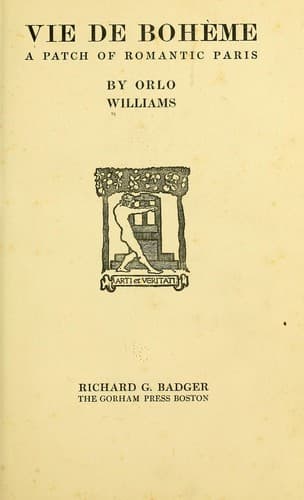
Vie de Bohème: A Patch of Romantic ParisWilliams, Orlo
History
Vie de Bohème: A Patch of Romantic Paris
Williams, Orlo
Paris (France) -- Intellectual life; Paris (France) -- Social life and customs
It is an unexpectedly pretty glimpse into a part of Bohemia where Murger
was not at home. When the quartets took place in a little square of the
Quartier Latin, students and _grisettes_ came to listen before the open
window, and workpeople on every story put out their heads to watch for
the arrival of the musicians. Murger's disreputable Schaunard, with his
symphony on _L'influence du bleu dans la musique_, was always, I must
confess, my favourite; but to discover that he played the quartets of
Haydn, Mozart, Beethoven, Schubert, and Mendelssohn for two hours a day
with Barbemuche and Marcel--well, it was an intoxicating vision.
Schaunard, who had a passion for lobsters, the composer (in his fleshly
form of Schann) of a famous drinking song, as second violin in a
Beethoven quartet--oh pleasant, pleasant fellow, who truly deserved to
come into the comfortable harbour of a toy-shop!
Marcel, so far as he was Champfleury, found a haven too, and lived till
1889. Colline retired to found a new religion in Switzerland, and
Rodolphe-Murger, though he lingered for some years in the band of
artists and writers who haunted the _brasserie_ where Courbet raised the
temple of realism, finally turned his back on dissipation and settled at
Marlotte, even now a charming village near Fontainebleau. His chief
recreation there was hunting, an occupation quite innocuous to the game,
if it be true that a certain hare survived his attentions for a whole
season, and when an unwary keeper shot it one misty afternoon, he
exclaimed with genuine compunction, "Tiens, c'est le lièvre de M.
Murger!" In 1861 he came to die in Paris of arteritis, and all the
literary world visited his bedside. He died two days after his admission
to the hospital, exclaiming, "Pas de musique! Pas de bruit! Pas de
Bohème!" Bohemia, indeed, had long been dead, and in his last moments he
may have recognized that it was well. There was no longer room for it in
a busier, a better-swept world. In its golden age Bohemia did no more
than share the imperfections of all human institutions. It had virtues,
a liberty, a pride, and an ideal of its own. Murger had seen the beauty
become a slattern, pretty no doubt beneath her smuts, gay in the midst
of her sorrows, but free by tolerance, not by protest, her pride almost
in the dust and her ideals in the possession of others. In the words
which Théodore Pelloquet spoke over his grave, Murger belonged to an
evil generation:
Public-domain text, read in full here on John Shaqi.
Reviews
Reviews
No reviews yet
Be the first to share your thoughts on this work.
Elsewhere in the archive
Join the Discussion
Join the discussion
Sign in to leave a comment or review.
Sign InorCreate an account