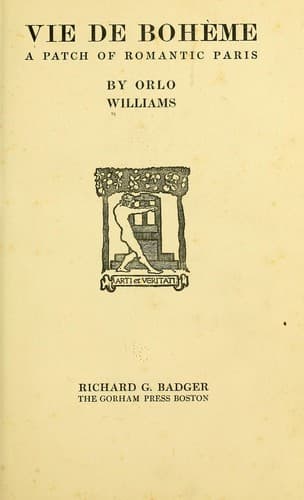
Vie de Bohème: A Patch of Romantic ParisWilliams, Orlo
History
Vie de Bohème: A Patch of Romantic Paris
Williams, Orlo
Paris (France) -- Intellectual life; Paris (France) -- Social life and customs
so far from being hidden, courts publicity. It takes its colour, too, so
largely from the changing world around that there is great pictorial
value in its easily observable vicissitudes. For that reason I devote
this chapter to the subject of its title without further apology, but
only with the caution that here the accidents rather than the essentials
of Bohemia are regarded. The privilege of amusement is open to
everybody, but to see what Bohemia made of its privileges in that
respect is, perhaps, to quicken it for the imagination by an extra
spark.
Precisians might say that dress hardly comes under the head of
amusements and that on certain views it is more properly included in the
category of necessities or of nuisances. Yet there is no doubt that for
all women--and for more men than would admit it--to be well dressed is
an enjoyment, a term only differing from amusement by a smaller
suggestion of possible frivolity. It is quite a sufficient warrant, at
all events, for giving dress a small part in this chapter; besides, the
costume of any individual or society is both a sure indicator of
qualities and an apt focus for judgment. In England, the very home of
illustrated books and papers, it is not necessary to say much in evoking
the costume of a past age, so that the subject may be treated quite
shortly, especially as regards the men of Bohemia, whose dress was too
often a deplorable tragedy. When Marcel went to Musette's party with
"Mathusalem" buttoned up to the neck over a blue shirt dotted with the
figures of a boar-hunt he was, as Murger says, "dressed in the worst
taste possible." In such a case there is no more to be said; his
appearance would vary little from age to age. To the Bohemian in his
lean days, certainly, it would be an insult to impute enjoyment of his
tattered wardrobe. Those who most enjoyed dressing, without a doubt,
were the Bohemian generation who cheered "Hernani" with such frenzy, for
they made their _pourpoints_, felt sombreros, Robespierre waistcoats,
and Phrygian caps effective details in the general Romantic
demonstration and, as such, matters of intense pleasure. But these
extravagances have already caught our attention; they were part of that
frantic desire for novelty and colour which was a symptom of _le mal
romantique_; their proper complement was that rage for fancy-dress balls
which broke out shortly after 1830 and laid every nationality and period
under contribution for picturesque costumes. So far as the men are
concerned, it need only be pointed out that the general dress of the
time--against which Bohemia stood out at first and into which it
gradually faded--was that of tight pantaloons with straps, long coats
with full skirts and accentuated waists, full cravats, lavish jewellery,
and high hats in a bewildering variety of shapes, cylindrical, conical,
inverted conical, curly, straight, with broad brims and with scarce a
brim at all--the civilian uniform, in fact, of our own late Georgian and
Public-domain text, read in full here on John Shaqi.
Reviews
Reviews
No reviews yet
Be the first to share your thoughts on this work.
Elsewhere in the archive
Join the Discussion
Join the discussion
Sign in to leave a comment or review.
Sign InorCreate an account