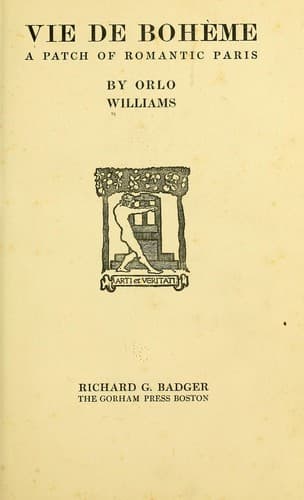
Vie de Bohème: A Patch of Romantic ParisWilliams, Orlo
History
Vie de Bohème: A Patch of Romantic Paris
Williams, Orlo
Paris (France) -- Intellectual life; Paris (France) -- Social life and customs
From the amusement of clothing the body it is an easy transition to that
of refreshing it. Eating and drinking, like dress, may from a certain
point of view come under the head of necessities, but indulgence in good
cheer when possible is a habit of young people of which a Bohemian was
by no means contemptuous. A word, therefore, about his particular haunts
among the thousand _cafés_ and restaurants of Paris will not be out of
season. After 1830 the great houses in the Palais Royal had fallen out
of fashion, and the four leading restaurants of Paris were on the
boulevard. Bohemians, it is true, were not often to be found within
them, but in the golden age, when Bohemia was nearer to the dandies and
_viveurs_, it would at least have been possible that in a moment of
extravagance some Bohemian friend should have accompanied Roger de
Beauvoir into the Café de Paris, the Café Riche, the Café Hardy, or the
Café Anglais. The Café de Paris was opposite Tortoni's, which stood at
the end of the Rue Taitbout. Besides being the home of the aristocratic
_petit cercle_, it was renowned for its witty conversation and its
general air of luxury. Since it was favoured by the aspirants to
smartness, as well as the perfect examples, its society was less select
than that of the Café Riche, at the corner of the Rue Lepeletier, or the
Café Anglais, which still remains in its old position. There was a quiet
solidity about the Café Anglais, in particular, which gave it a peculiar
air of distinction, though its company was gay enough at supper-time. It
was especially famous for its roast meat and its grills, though in these
matters the Café Hardy, at the corner of the Rue Laffitte, ran it close.
Hardy was an English cook who invented the _déjeuner à la fourchette_,
and popularized it by setting up the first silver grill in Paris.
Customers chose their own cutlet or steak and saw it cooked before their
eyes. At all these four the prices were very high, and with regard to
two of them it was said: "On doit être riche pour dîner au Café Hardy,
et hardi pour dîner au Café Riche." However, the chief haunt for
Bohemians with money to spend was the Rocher de Cancale, where it was
easier to be uproarious without offending the proprieties. This famous
restaurant still stands in the dirty, provincial Rue Montorgueil, in the
midst of small shops whose wares overflow on to the pavement. The
stately ornamentation of dark painted wood is still visible on its upper
stories, but the specimens of edibles in its ground-floor windows tell
too plainly to what depths it has sunk. It is no longer a possible home
for Rastignac and his boon companions, nor would it tempt Arsène
Houssaye to entertain there the brethren of _la Bohème galante_, for it
merely plies the trade of the convenient _marchand de vin_ in a rather
squalid quarter. The Rocher de Cancale had declined already during the
later days of Bohemia, and in Murger's day they repaired on _jours de
Public-domain text, read in full here on John Shaqi.
Reviews
Reviews
No reviews yet
Be the first to share your thoughts on this work.
Elsewhere in the archive
Join the Discussion
Join the discussion
Sign in to leave a comment or review.
Sign InorCreate an account