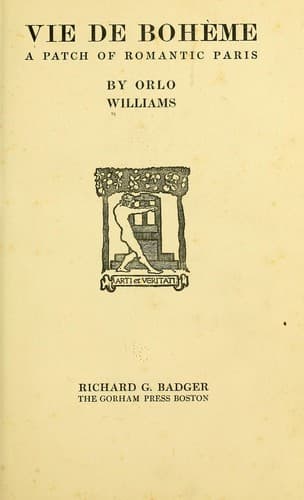
Vie de Bohème: A Patch of Romantic ParisWilliams, Orlo
History
Vie de Bohème: A Patch of Romantic Paris
Williams, Orlo
Paris (France) -- Intellectual life; Paris (France) -- Social life and customs
The extent to which Bohemia, at its different phases, shared in the
various pastimes of Paris cannot be determined with any accuracy, so
much depended on individual taste and individual wealth. It is certain,
however, that after 1837 gambling was not a Bohemian distraction, for in
that year the public gaming-houses were closed. Before that time they
were such a popular institution that the early Bohemia cannot be
conceived to have entirely eschewed it. At the beginning of "La Peau de
Chagrin" Balzac draws a powerful picture of the wretched crowd that
haunted the Palais Royal, where Raphael de Valentin lost his last gold
coin at a single coup. There were no less than four gaming-houses in the
Palais Royal, Nos. 9, 113, 124, and 129, where the minimum stake was two
francs for roulette and five francs for trente-et-un. Besides the
Palais Royal, there were Paphos, Frascati, and the select Cercle des
Étrangers. The popularity of gambling can be judged from the fact that
the Treasury profited annually by it to the extent of five and a half
million francs. Yet there is no record that the truly artistic members
of Bohemia, like Gautier or Houssaye, so wasted time or money, while
Murger and his friends were spared the temptation. In music, too,
Bohemia played no very great part, in spite of the devotion of
Champfleury, Barbara, and Schann to Beethoven's quartets. There was
plenty of fine music to be heard in Paris during the time: Habeneck was
introducing Beethoven's symphonies, Berlioz was revolutionizing
orchestration, while Liszt, Chopin, Paganini, Vieuxtemps, and de Bériot
were among the soloists. Certainly those Bohemians of the golden age who
had access to the _salons_ of the Princess Belgiojoso or Madame de
Girardin must often have heard these great artists, but it is not to be
supposed that they were great supporters of concerts, unless it were of
the Concerts Musard. These concerts, which won great fame through the
personality of Musard, the conductor, began in 1833 in the Salle
Saint-Honoré;[31] their programmes were excellent and the prices low
enough to attract the least well off. Musard had a genius for making
_pot-pourris_ of operatic tunes and for introducing new effects,
especially into dance music. His electric style of conducting made the
Bals Musard far more popular than the great balls at the Opéra. He
contrived a wonderful quadrille, for instance, out of "Les Huguenots,"
during which red lights were lit, tocsins pealed, tom-toms boomed,
screams resounded, and the whole illusion of a massacre was thrillingly
kept up. He also composed a _contre-danse_ in the finale of which he
broke a chair, and his triumph was a certain galop in which he
discharged a pistol. This was thoroughly in keeping with the Romantic
spirit, and after its first performance he was publicly chaired round
the hall by the excited dancers. So far as pure music was concerned,
however, it appealed most to Parisians in the form of opera. Meyerbeer's
Public-domain text, read in full here on John Shaqi.
Reviews
Reviews
No reviews yet
Be the first to share your thoughts on this work.
Elsewhere in the archive
Join the Discussion
Join the discussion
Sign in to leave a comment or review.
Sign InorCreate an account