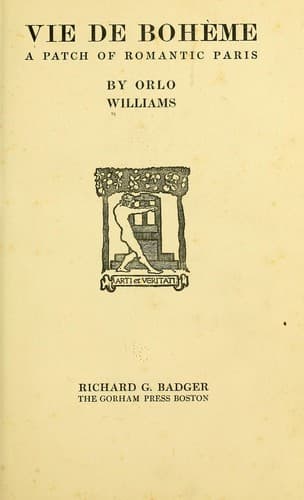
Vie de Bohème: A Patch of Romantic ParisWilliams, Orlo
History
Vie de Bohème: A Patch of Romantic Paris
Williams, Orlo
Paris (France) -- Intellectual life; Paris (France) -- Social life and customs
of its livelihood: it lived next door to that special world composed of
actors and actresses. Yet, though Bohemians went to supper with
Mademoiselle Mars, Dumas was very much at home with Marie Dorval, Roger
de Beauvoir played pranks with Bache, and Rodolphe had a love affair
with Mademoiselle Sidonie, the two worlds were definitely separated. In
fact, the life of dramatic artists, whatsoever Bohemian flavouring it
may have, has always had a mysterious taste of its own, incapable of
mixture with any other blend of artistic life, so that, interesting as
it may have been in Paris during these years, its omission from these
pages has been intentional.
[Illustration: Bal Masqué à l'Opéra]
The one other amusement--a pure pastime involving no material
profit--which was particularly popular in Bohemia was dancing. In this
respect Bohemia was no exception from the rest of Parisian society, for
in all classes there was an inextinguishable passion for the dance. But
the Bohemian, obeying only his own laws of social propriety, was in a
more favourable position for taking full advantage of all public
opportunities for this exercise and of all the _agréments_ in the way of
casual intercourse with both sexes which it implied. All the year round
there were public balls given in Paris, at which the Bohemian was in his
element, giving rein to his inventive humour, his high spirits, and his
gift of seductive gallantry. During the first few years after 1830, the
golden age of Bohemia, the balls at the Opéra were the most frequented,
especially in the days of the carnival. There masks and dominoes covered
dancers of every rank in society, for even the _femme du monde_ slipped
in unbeknown to her husband. This scene of utmost gaiety and brilliance,
of which Balzac gives a picture at the opening of "Splendeurs et Misères
des Courtisanes," was closely rivalled by the ball at the Variétés, at
which a still more feverish excitement reigned. Or if the Bohemian
preferred to make sure of a _grisette_ as a partner he went to the
Prado, the site of which was opposite the Palais de Justice, where,
under Pilodo, the famous conductor, he could join Louise la Balocheuse,
Angelina l'Anglaise, or Ernestine Confortable in the giddy whirl. The
waltz was recognized at this period, but the quadrille easily held the
place of honour, especially as it lent itself more freely to individual
invention, such as Ourliac's magnificent variation depicting the
grandeur and fall of Napoleon. It was through this licence in the
figures of the quadrille that the _chahut_ and the _cancan_ were
introduced by the rakish set among the _viveurs_ which included Charles
de la Battut, Alton-Shee, Monnier, and the famous Chicard--a
leather-merchant who made a name by his grotesque costumes and wild
dances, the term _chicard_, which degenerated into _chic_, becoming a
general denomination for his imitators. I have not been able to arrive
at the difference between the _chahut_ and the _cancan_, but both were
Public-domain text, read in full here on John Shaqi.
Reviews
Reviews
No reviews yet
Be the first to share your thoughts on this work.
Elsewhere in the archive
Join the Discussion
Join the discussion
Sign in to leave a comment or review.
Sign InorCreate an account