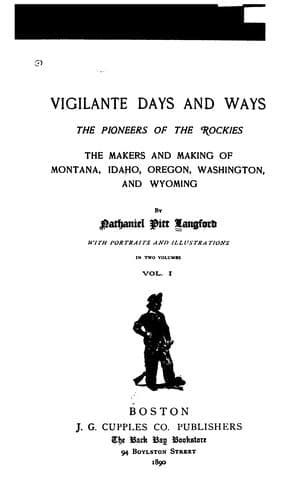
Vigilante Days and Ways: The pioneers of the Rockies; the makers and making of Montana and IdahoLangford, Nathaniel Pitt
History
Vigilante Days and Ways: The pioneers of the Rockies; the makers and making of Montana and Idaho
Langford, Nathaniel Pitt
Frontier and pioneer life -- Northwestern States; Northwestern States -- History; Vigilance committees; West (U.S.) -- History
Life in Bannack at this time was perfect isolation from the rest of the
world. Napoleon was not more of an exile on St. Helena than the newly
arrived immigrant from the States, in this recess of rocks and
mountains. All the stirring battles of the season of 1862,—Antietam,
Fredericksburg, and Second Bull Run,—all the exciting debates of
Congress, and the more exciting combats at sea, first became known to us
on the arrival of the first newspapers and letters, in the Spring of
1863. Old newspapers went the rounds of the camps until they literally
dropped to pieces. Pamphlets, cheap publications, and yellow-covered
literature, which had found their way by chance into the camp, were in
constant and unceasing demand. Bibles, of which there were a few copies,
were read by men who probably never read them before, to while away the
tedium of the dreary days of winter. Of other books there were none
then, nor for a year or more afterwards. Euchre, old sledge, poker, and
cribbage were resorted to until they became stale, flat, and disgusting.
When, afterwards, the first small library was brought into the
Territory, the owner was at once overwhelmed with borrowers, who, after
reading, loaned his books without leave, until the loss or destruction
of many of them drove him to the adoption of means for the preservation
of the remainder. He placarded over his library, where all could read
it, the following passage from Matthew xxv. 9: “Not so; lest there be
not enough for us and you; but go ye rather to them that sell, and buy
for yourselves.” This gentle hint served better as a joke than an
admonition.
As a counterpoise to this condition of affairs, the newcomer found much
in the rough, wild scenery, the habits, customs, and dress of the
miners, and in the pursuits of the camp, to interest his attention.
There was a freedom in mountain life entirely new to him. The common
forms of expression, rough, unique, and full of significance, were such
as he had never been accustomed to hear. The spirit of a humor full of
fun, displaying itself practically on all occasions, often at his own
expense, presented so many new phases of character, that he was seldom
at a loss for agreeable pastime, or, indeed, profitable occupation.
Public-domain text, read in full here on John Shaqi.
Reviews
Reviews
No reviews yet
Be the first to share your thoughts on this work.
Elsewhere in the archive
Join the Discussion
Join the discussion
Sign in to leave a comment or review.
Sign InorCreate an account