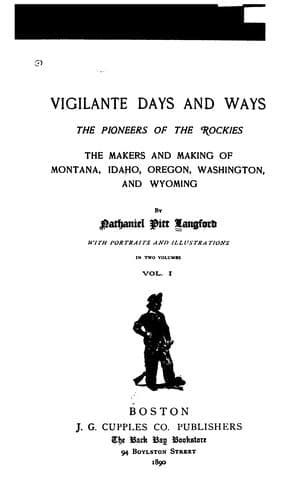
Vigilante Days and Ways: The pioneers of the Rockies; the makers and making of Montana and IdahoLangford, Nathaniel Pitt
History
Vigilante Days and Ways: The pioneers of the Rockies; the makers and making of Montana and Idaho
Langford, Nathaniel Pitt
Frontier and pioneer life -- Northwestern States; Northwestern States -- History; Vigilance committees; West (U.S.) -- History
The details I have here given of this battle, while they sufficiently
demonstrate the skill and bravery of the officers and men by whom it was
fought, would be wanting in justice to them did I fail to mention other
incidental facts connected with it, which entitle them to additional
claims upon our gratitude and admiration. Few people who have never
experienced a winter in the Rocky Mountains know how to appreciate the
elemental difficulties attending the march of such an expedition as this
one of General Connor’s. The sudden storms, the deep snows, the
trackless wastes, the rapid, half-frozen mountain torrents, the lofty
divides, the keen blasts, and the pinching nights, coupled with all the
unavoidable demands which must encumber the movements of troops and
artillery through a country that for most of the distance is entirely
desolate, should give this expedition a conspicuous place among the
remarkable events of our country’s history. Seventy-four of the number
engaged in it had their feet frozen by exposure. The night rides of the
cavalry to overtake the infantry would furnish as thrilling a theme for
song as any of the rides during our National struggle, which have been
thus immortalized. The transportation of munitions, camp equipage, and
heavy artillery through eighty miles of snow, which for most of the
distance was unmarked by a road, over mountains, through cañons, and
across unbridged streams, furnishes a chapter that can find no parallel
in our former military experience. I mention them, that my readers may
form some idea of the amount of labor and care necessary to carry such
an enterprise through with success, and give the proper credit to those
who accomplished it.
Through the kindness of General Connor I am enabled to give the names
and rank of those who were killed and wounded. All the officers and men
fought with great bravery. General Connor himself, during the entire
four hours the battle was in progress, was always in the thickest of it,
and seldom out of range of the deadly rifles of the Indians. The
historian of the battle says:
“General Connor exhibited high qualities of command, and his perfect
coolness and bravery are the universal theme of praise. Possibly some
might have been better pleased with less exposure of their commander,
but I have the best authority for saying it was the call of duty, and
not indifference.”
The object of the fight was fully accomplished. Two hundred and
sixty-seven Indians were killed, several of their leading chiefs among
the number. Not fifteen escaped to tell the story of the battle.
Public-domain text, read in full here on John Shaqi.
Reviews
Reviews
No reviews yet
Be the first to share your thoughts on this work.
Elsewhere in the archive
Join the Discussion
Join the discussion
Sign in to leave a comment or review.
Sign InorCreate an account