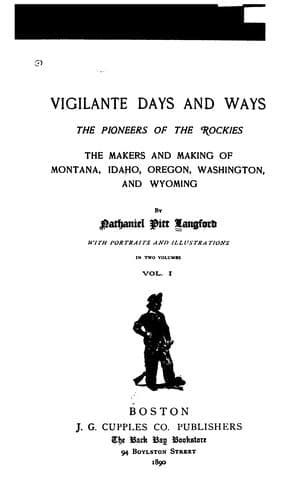
Vigilante Days and Ways: The pioneers of the Rockies; the makers and making of Montana and IdahoLangford, Nathaniel Pitt
History
Vigilante Days and Ways: The pioneers of the Rockies; the makers and making of Montana and Idaho
Langford, Nathaniel Pitt
Frontier and pioneer life -- Northwestern States; Northwestern States -- History; Vigilance committees; West (U.S.) -- History
Dr. Steele, president of the gulch, acted as judge. He united with much
native good sense, great modesty of demeanor. He was not a lawyer. On
his trip from the States, while crossing the plains, an unfriendly gust
had swept his only hat beyond recovery, and he came into Montana with
his brows bound in a parti-colored cotton handkerchief, which, for want
of something more appropriate, not obtainable at the stores, he had worn
until some friendly miner possessing an extra hat presented him with it.
Proving too small to incase his intellectual organs, the doctor had, by
a series of indented slits encircling the rim, increased its elasticity,
so that, saving a succession of gaps, through which his hair bristled
“like quills upon the fretful porcupine,” it answered the purpose of its
creation. With this upon his head he sat upon the bench, an embodiment
of the dignity, law, and learning of this little mountain judiciary.
In the progress of the trial, the defendant’s counsel asked for a
nonsuit, on account of some informality of service.
“A what?” inquired the judge with a puzzled expression, as if he had not
rightly understood the word.
“A nonsuit,” was the rejoinder.
“What’s a—” The question partly asked, was left incomplete. The judge
blushed, but reflecting that he would probably learn the office of a
nonsuit in the course of the argument, he broke through the dilemma by
asking,
“Upon what ground?”
The argument followed, and the judge, soon comprehending the meaning of
a nonsuit, decided that unless the defendant could show that he had
suffered by reason of the informal service, the case must proceed. Some
of the friends of the magistrate, seated near the door, understanding
the cause of his embarrassment, enjoyed the scene hugely, and as it
presented an opportunity for returning in kind some of the numerous
jokes which he had played at their expense, one of them, thinking it too
good to be lost, with much mock sobriety of manner and tone, arose and
said,
“Most righteous decision!”
All eyes were turned upon the speaker, but before they could comprehend
the joke at the bottom, another arose, and with equal solemnity,
exclaimed,
“Most just judge!”
Dr. Steele, though embarrassed by this ill-timed jocularity, was so well
satisfied with his sagacity in finding out what a nonsuit meant, without
betraying his legal unlearnedness, that the joke was taken in good part,
and formed a subject of frequent merriment in after times.
Public-domain text, read in full here on John Shaqi.
Reviews
Reviews
No reviews yet
Be the first to share your thoughts on this work.
Elsewhere in the archive
Join the Discussion
Join the discussion
Sign in to leave a comment or review.
Sign InorCreate an account