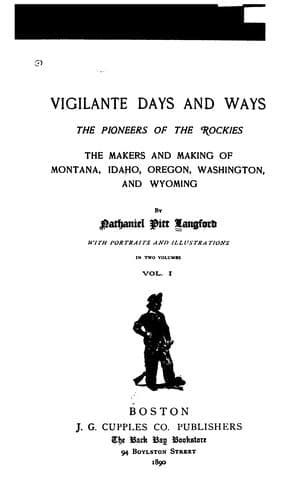
Vigilante Days and Ways: The pioneers of the Rockies; the makers and making of Montana and IdahoLangford, Nathaniel Pitt
History
Vigilante Days and Ways: The pioneers of the Rockies; the makers and making of Montana and Idaho
Langford, Nathaniel Pitt
Frontier and pioneer life -- Northwestern States; Northwestern States -- History; Vigilance committees; West (U.S.) -- History
In the purchases which he made of the ranchemen he sometimes detected
their dishonest tricks, and generally punished them on the spot. On one
occasion, while bargaining for a stack of hay, he discovered that it was
filled with bushes. He told the rancheman that he intended to confine
him to the stack with chains, and burn him, and commenced making
preparations, seemingly for that purpose. The man begged for his life,
and, with much apparent reluctance, Slade finally told him if he would
leave the country and never return to it he would give him his life.
Glad of the compromise the fellow departed the next morning. This was
all that Slade desired.
Stories like these grate harshly upon the ears of people who have always
lived in civilized communities. Without considering the influences by
which he is surrounded, this class pronounce such a man a ruffian. An
author who writes of him finds it no task to blacken his memory, by
telling half the truth. People who have once heard of him are prepared
to believe any report which connects his name with crime. Wrong as this
is on general principles, it has been especially severe in the case of
Slade. Misrepresentation and abuse have given to him the proportions,
passions, and actions of a demon. His name has become a synonym for all
that is infamous and cruel in human character. And yet not one of all
the great number of men he controlled, or of those associated with him
as employees of the Overland Stage company, men personally cognizant of
his career, believe that he committed a single act not justified by the
circumstances provoking it.
He could not be true to his employers and escape censure, any more than
he could have discharged the duties expected of him without frequent and
dangerous collision with the rough elements of the society in which he
moved. That he lived through it all was a miracle. A man of weaker
resolution, and less fertility of resource, would have been killed
before the close of his first year’s service. Equally strange is it,
that one whose daily business required a continual exercise of power in
so many and varied forms, at one moment among his own employees, at the
next among the half-civilized borderers by whom he was surrounded, and
perhaps at the same time sending out men in pursuit of horse-thieves,
should have escaped with so few desperate and bloody encounters.
The uniform testimony of those who knew him is, that he was rigidly
honest and faithful. He exacted these qualities from those in his
employ. Among gentlemen he was a gentleman always. He had no bad habits
at that time. Men who were brought in daily contact with him, during his
period of service, say that they never saw him affected by liquor. He
was generous, warmly attached to his friends, and happy in his family.
He was of a lively, cheerful temperament, full of anecdote and wit, a
pleasant companion, whose personal magnetism attached his friends to him
with hooks of steel.
Public-domain text, read in full here on John Shaqi.
Reviews
Reviews
No reviews yet
Be the first to share your thoughts on this work.
Elsewhere in the archive
Join the Discussion
Join the discussion
Sign in to leave a comment or review.
Sign InorCreate an account