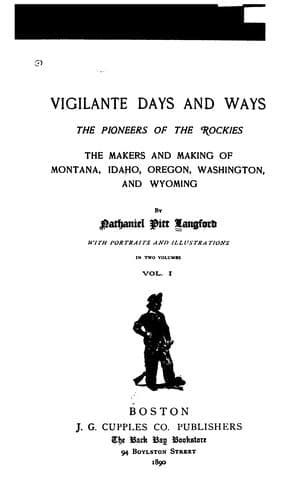
Vigilante Days and Ways: The pioneers of the Rockies; the makers and making of Montana and IdahoLangford, Nathaniel Pitt
History
Vigilante Days and Ways: The pioneers of the Rockies; the makers and making of Montana and Idaho
Langford, Nathaniel Pitt
Frontier and pioneer life -- Northwestern States; Northwestern States -- History; Vigilance committees; West (U.S.) -- History
This is the history of the quarrel between Slade and Jules Reni, as I
have received it from a gentleman familiar with all its phases from its
commencement to its close. The aggravated form in which the narrative
has been laid before the public, charging Slade with having tied his
victim to a tree, and firing at him at different times during the day,
taunting him meantime, and subjecting him to a great variety of torture,
before killing him, is false in every particular. Jules was not only the
first, but the most constant aggressor. In a community favored with laws
and an organized police, Slade would not have been justified in the
course he pursued, yet, under our most favored institutions, more
flagrant cases than this daily escape conviction. In the situation he
accepted, an active business man, intrusted with duties which required
constant exposure of his person both night and day, what else could he
do, to save his own life, than kill the person who threatened and sought
an opportunity to take it? Law would not protect him. The promise which
Jules had made with the halter about his neck, to leave the country, did
not prevent his return to avenge himself upon Slade. It was impossible
to avoid a collision with him; and to kill him under such circumstances
was as clear an act of self-defence, as if, in a civilized community, he
had been slain by his adversary with his pistol at his heart.
Slade’s career, relieved from the infamy of this transaction, presents
no feature for severe public condemnation, until several years after its
occurrence. He retained his position as division agent, discharging his
duties acceptably, and was, in fact, regarded by the company as their
most efficient man. When the route was changed from Laramie to the
Cherokee Trail, he removed his headquarters to a beautiful nook in the
Black Hills, which he named Virginia Dale, after his wife, whom he loved
fondly.
His position as division agent often involved him unavoidably in
difficulty with ranchemen and saloon-keepers. At one time, after the
violation of a second request to sell no liquor to his employees, Slade
riddled a wayside saloon, and poured the liquor into the street. On
another occasion, seemingly without provocation, he and his men took
possession of the sutler’s quarters at Fort Halleck, and so conducted
themselves as to excite the animosity of the officers of the garrison,
who determined to punish him for the outrage. Following him in the coach
to Denver, they arrested and would not release him, until the company
assured them he should leave the division.
Public-domain text, read in full here on John Shaqi.
Reviews
Reviews
No reviews yet
Be the first to share your thoughts on this work.
Elsewhere in the archive
Join the Discussion
Join the discussion
Sign in to leave a comment or review.
Sign InorCreate an account