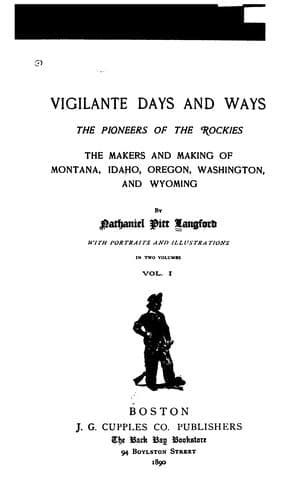
Vigilante Days and Ways: The pioneers of the Rockies; the makers and making of Montana and IdahoLangford, Nathaniel Pitt
History
Vigilante Days and Ways: The pioneers of the Rockies; the makers and making of Montana and Idaho
Langford, Nathaniel Pitt
Frontier and pioneer life -- Northwestern States; Northwestern States -- History; Vigilance committees; West (U.S.) -- History
In the meantime, John White and a small party of prospectors had
discovered the gold placer in the cañon of Grasshopper Creek which
afterwards became Bannack. When the companies of McLean and Russell
arrived there, their stock of provisions was nearly exhausted. They went
to Deer Lodge, hoping to find a more promising field, and some of them
visited the placers on Gold Creek, Pioneer, and at Pike’s Peak Gulch,
none of which were equal in richness and extent to the one they had left
behind them. They returned to Grasshopper. No provisions having arrived
in the country, most of them decided to attempt a return to Salt Lake
City. The chance of making a journey of four hundred miles to the
nearest Mormon settlements was preferable to starvation in this desolate
region. They could but die in the effort, and might succeed. After they
had started on this Utopian journey, Russell mounted his horse, followed
them, and persuaded them to return. They then set to work in good
earnest and found gold in abundance; but, with the fortune of Midas, as
their scanty supply of food lessened daily, they feared soon to share
his fate also, and have nothing but gold to eat. Just at this crisis,
however, their Pactolus appeared in the shape of a large train of
provisions belonging to Mr. Woodmansee, and all fear of starvation
vanished. The step between the extremes of misery and happiness was, in
this case, very short. The camp was hilarious with joy and mirth.
Upon the opening of Spring, Russell left Grasshopper on his return to
Colorado, where he arrived in safety after encountering dangers enough
to fill a moderate volume. For two days, while passing through Marsh
Valley, he was pursued by Indians, barely escaping being shot and
scalped. His courage was often put to the strongest tests. At Wood
River, twenty miles from Fort Lemhi, the Bannack Indians offered him
money in large amounts for fire-arms and ammunition. They stole a pistol
from him. Accompanied by one Gibson, he went to their camp and recovered
it. Some of them were dressed in the apparel of women whom they had
murdered, and whose bodies they had concealed in the fissures of the
lava beds on Snake River. More than two hundred emigrants had been
killed by these wretches the preceding Summer.
Russell exhibited specimens of the gold taken from the “Grasshopper
diggings,” to his friends in Colorado. The excitement it occasioned was
intense, and when the Spring of 1863 opened, large numbers left for the
new and promising El Dorado.
In the Fall of 1862 there stood, on the bank at the confluence of
Rattlesnake Creek and the Beaverhead River, a sign-post with a
rough-hewn board nailed across the top, with the following intelligence
daubed with wagon-tar thereon:
Tu grass Hop Per digins
30 myle
☞ kepe the Trale nex the bluffe
On the other side of the board was the following:
Public-domain text, read in full here on John Shaqi.
Reviews
Reviews
No reviews yet
Be the first to share your thoughts on this work.
Elsewhere in the archive
Join the Discussion
Join the discussion
Sign in to leave a comment or review.
Sign InorCreate an account