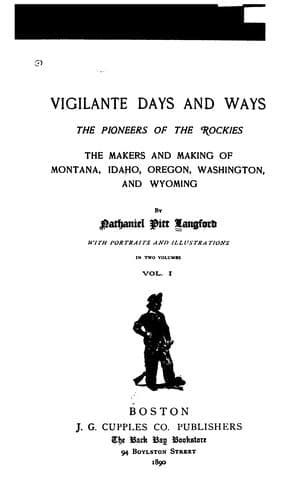
Vigilante Days and Ways: The pioneers of the Rockies; the makers and making of Montana and IdahoLangford, Nathaniel Pitt
History
Vigilante Days and Ways: The pioneers of the Rockies; the makers and making of Montana and Idaho
Langford, Nathaniel Pitt
Frontier and pioneer life -- Northwestern States; Northwestern States -- History; Vigilance committees; West (U.S.) -- History
In the brief colloquy which took place between them, Plummer asked
Crawford no less than three times what Jack had said about him. His past
career of crime was all before him. Crawford as often replied,
“Nothing.”
“’Tis well he did not,” at length responded Plummer, “for if he had I
would kill him in his bed.”
Crawford then told him that, in reply to several questions asked him,
Cleveland had said,
“Poor Jack has got no friends. He has got it [meaning his death-wound]
and I guess he can stand it.”
Crawford left with the impression that Plummer still thought Cleveland
had exposed him, and was careful afterwards to go armed, as he felt that
his own life was in danger. Cleveland lingered in great agony for three
hours, and was decently buried by Crawford. Soon after he had been
removed to Crawford’s cabin, Plummer sent a man known as “Dock,” a cook,
into the cabin as a spy, where he remained until Cleveland died. He said
that the only reply Phleger received to repeated questions concerning
the difficulty between him and Plummer was, “It makes no difference to
you.” The secret, if secret there was, died with him.
No immediate investigation was made of the circumstances of this affray.
It was thought by many that Plummer merely anticipated Cleveland’s
intention by firing first. Shooting of pistols and duelling were so
common as of themselves to excite no attention. Many bloody encounters
took place of which no record has been preserved, and which at the time
were regarded as very proper settlements of difficulties between the
parties.
A few incidents as illustrative of the customs of a mining camp will not
be out of place in this immediate connection. On one occasion during the
winter a quarrel sprung up between George Ives and George Carrhart in
the main street. After a long wordy war interlarded with much profanity
and various opprobrious epithets, Ives ran into a near saloon for his
pistol, exclaiming, “I will shoot you.” Carrhart followed him and both
reappeared at the door of the saloon a moment thereafter, each armed
with a revolver. Facing each other upon the instant, both parties raised
their pistols and fired without effect. After a second fire with no
better effect, both parties walked rapidly backwards till they were
widely separated, at the same time firing upon each other. Ives having
emptied his revolver, stood perfectly still while Carrhart took
deliberate aim and shot him in the groin, the ball passing through his
body, inflicting a severe wound. Soon afterwards they reconciled their
difficulties, and Ives lived with Carrhart on his ranche the remainder
of the winter.
Public-domain text, read in full here on John Shaqi.
Reviews
Reviews
No reviews yet
Be the first to share your thoughts on this work.
Elsewhere in the archive
Join the Discussion
Join the discussion
Sign in to leave a comment or review.
Sign InorCreate an account