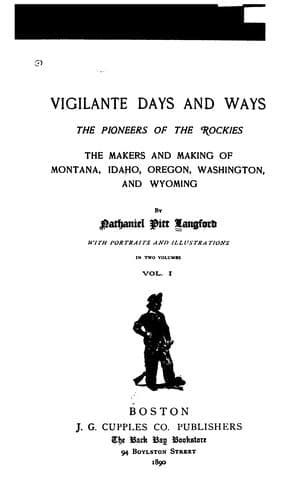
Vigilante Days and Ways: The pioneers of the Rockies; the makers and making of Montana and IdahoLangford, Nathaniel Pitt
History
Vigilante Days and Ways: The pioneers of the Rockies; the makers and making of Montana and Idaho
Langford, Nathaniel Pitt
Frontier and pioneer life -- Northwestern States; Northwestern States -- History; Vigilance committees; West (U.S.) -- History
At a late hour the people separated with the purpose of assembling for
the trial of Moore, Reeves, and Mitchell early the next morning. Day
broke clear and cold. All work was suspended in the gulch, stores and
hotels were abandoned, and the entire population, numbering at least
four hundred persons, assembled in and about the large log building
which had been designated as the place of trial. Every man was armed,
some with rifles and shotguns, others with pistols and knives. The
friends of the prisoners gave free utterance to threats, which they
accompanied with much profane assumption of superior power and many
defiant demonstrations. Pistols were flourished and discharged, oaths
and epithets freely bestowed upon the citizens, and whatever vehemence
of gesture and expression could do to intimidate the people, was
adopted. Amid all this bluster it was apparent from the first that the
current of popular opinion set strongly against the prisoners. There was
an air of quiet determination manifested in every movement preparatory
for the trial. The citizens were ready for an outbreak, and the least
indication in that direction would have been the signal for a bloody and
decisive battle. It is not improbable that an attempt at rescue was
prevented by the presence of the overpowering force of armed and
indignant citizens.
The efforts of the roughs to suppress the trial only increased the
indignation of the people, and after electing a temporary chairman, a
motion was made that the accused be tried by a miners’ court. This form
of tribunal grew out of the necessities of mining life in the mountains.
It originated in the early days of California, when the country was
destitute of courts and law, and still exists in inchoate mining
communities as a witness to the fairness and honesty of American
character. It is now the general custom among the property holders of a
mining camp, as the first step towards organization, to elect a
president or judge, who is to act as the judicial officer of the
district. He has both civil and criminal jurisdiction. All questions
affecting the rights of property, and all infractions of the peace, are
tried before him. When complaint is made to him, it is his duty to
appoint the time and place of trial in written notices which contain a
brief statement of the matter in controversy, and are posted in
conspicuous places throughout the camp. The miners assemble in force to
attend the trial. The witnesses are examined, either by attorneys or by
the parties interested, and when the evidence is closed the judge states
the question at issue, desiring all in favor of the plaintiff to
separate from the crowd in attendance until they can be counted, or to
signify by a vote of “aye” their approval of his claim. The same forms
are observed in the decision of a criminal case. The decision is
announced by the judge and entered upon his record. Where the punishment
is death, the criminal is generally allowed one hour to arrange his
Public-domain text, read in full here on John Shaqi.
Reviews
Reviews
No reviews yet
Be the first to share your thoughts on this work.
Elsewhere in the archive
Join the Discussion
Join the discussion
Sign in to leave a comment or review.
Sign InorCreate an account