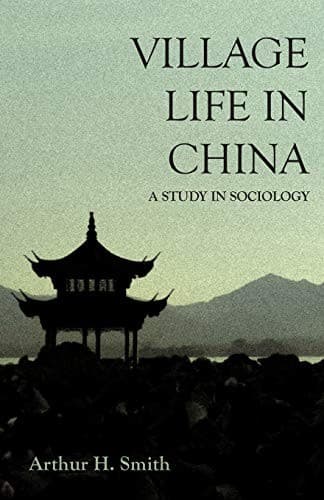
Village Life in China: A Study in SociologySmith, Arthur H.
General
Village Life in China: A Study in Sociology
Smith, Arthur H.
China -- Social life and customs; Villages
The most ordinary explanation of a comparatively rare phenomenon of a
village without a temple, is that the hamlet is a small one and cannot
afford the expense. Sometimes it may have been due to the fact that there
was no person of sufficient intelligence in the village to take the
initial steps, and as one generation is much influenced by what was done
and what was not done in the generations that have passed, five hundred
years may elapse without the building of a temple, simply because a temple
was not built five hundred years ago. In the very unusual cases where a
village is without one, it is not because they have no use for the gods;
for in such instances the villagers frequently go to the temples of the
next village and "borrow their light," just as a poor peasant who cannot
afford to keep an animal to do his plowing may get the loan of a donkey in
planting time, from a neighbour who is better off.
The two temples which are most likely to be found, though all others be
wanting, are those of the local god, and of the god of war. The latter has
been made much of by the present dynasty, and greatly promoted in the
pantheon. The former is regarded as a kind of constable in the next world,
and he is to be informed promptly on the death of an adult, that he may
report to the city god ("Ch'êng Huang,") who in turn reports to Yen Wang,
the Chinese Pluto.
In case a village has no temple to the T'u-ti, or local god, news of the
death is conveyed to him by wailing at the crossing of two streets, where
he is supposed to be in ambush.
Tens of thousands of villages are content with these two temples, which
are regarded as almost indispensable. If the village is a large one,
divided into several sections transacting their public business
independently of one another, there may be several temples to the same
divinity. It is a common saying, illustrative of Chinese notions on this
topic, that the local god at one end of the village has nothing to do with
the affairs of the other end of the village.
Public-domain text, read in full here on John Shaqi.
Reviews
Reviews
No reviews yet
Be the first to share your thoughts on this work.
Elsewhere in the archive
Join the Discussion
Join the discussion
Sign in to leave a comment or review.
Sign InorCreate an account