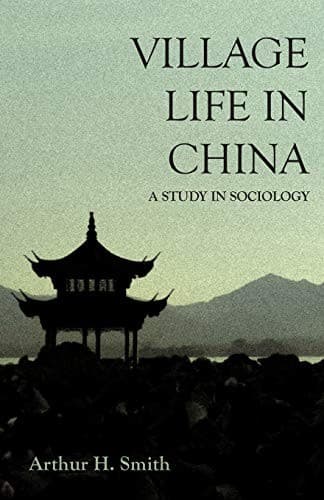
Village Life in China: A Study in SociologySmith, Arthur H.
General
Village Life in China: A Study in Sociology
Smith, Arthur H.
China -- Social life and customs; Villages
"Mountain Societies" are of two sorts, the "Travelling," (_hsing-shan
hui_), and the "Stationary," (_tso-shan hui_). The former lays plans for a
visit to the sacred mountain, and for the offering of a certain amount of
worship at the various temples there to be found. The latter is a device
for accomplishing the principal results of the society, without the
trouble and expense of an actual visit to a distant and more or less
inaccessible mountain peak. The recent repeated outbreaks of the Yellow
River which must be crossed by many of the pilgrims to the Great Mountain,
have tended greatly to diminish the number of "Travelling Societies," and
to increase the number of the stationary variety.
When the three years of accumulation have expired, the managers call in
all the money, and give notice to the members who hold a feast. It is then
determined at what date a theatrical exhibition shall be given, which is
paid for by the accumulation of the assessments and the interest. If the
members are natives of several different villages, a site may be chosen
for the theatricals convenient for them all, but without being actually in
any one of them. At other times the place is fixed by lot.
During the performance of the theatricals, generally three days or four,
the members of the society are present, and may be said to be their own
guests and their own hosts. For the essential part of the ceremony is the
eating, without which nothing in China can make the smallest progress. The
members frequently treat themselves to three excellent feasts each day,
and in the intervals of eating and witnessing theatricals, they find time
to do more or less worshipping of an image of the mountain goddess (_T'ai
Shan niang-niang_) at a paper "mountain," which by a simple fiction is
held to be, for all intents and purposes, the real Great Mountain. While
there does not appear to be any deeply-seated conviction that there is
greater merit in actually going to the real mountain than in worshipping
at its paper representative at home, this almost inevitable feeling
certainly does exist, and it expresses itself forcibly in nicknaming the
stationary kind "squatting and fattening societies" (_tun-piao hui_). But
while the Chinese are keenly alive to the inconsistencies and absurdities
of their practices and professions, they are still more sensible of the
delights of compliance with such customs as they happen to possess,
without a too close scrutiny of "severe realities." The religious
societies of the Chinese, faulty as they are from whatever point of view,
do at least satisfy many social instincts of the people, and are the media
by which an inconceivable amount of wealth is annually much worse than
wasted. It is a notorious fact, that some of those which have the largest
revenues and expenditures, are intimately connected with gambling
practices.
Public-domain text, read in full here on John Shaqi.
Reviews
Reviews
No reviews yet
Be the first to share your thoughts on this work.
Elsewhere in the archive
Join the Discussion
Join the discussion
Sign in to leave a comment or review.
Sign InorCreate an account