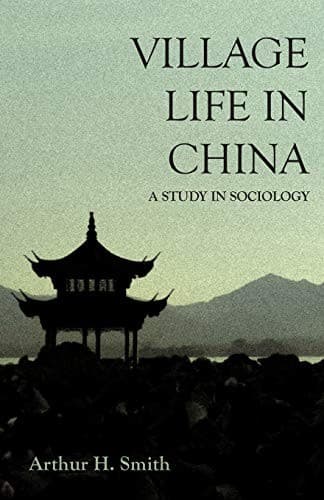
Village Life in China: A Study in SociologySmith, Arthur H.
General
Village Life in China: A Study in Sociology
Smith, Arthur H.
China -- Social life and customs; Villages
If any contributor to the travelling society, or to any other of a like
nature, should be unable to attend the procession to the mountain, or to
go to the temple where worship is to be offered, his contribution is
returned to him intact, but the interest he is supposed to devote to the
virtuous object of the society, for he never sees any of it.
The countless secret sects of China, are all of them examples of the
Chinese talent for coöperation in the alleged "practice of virtue." The
general plan of procedure does not differ externally from that of a
religious denomination in any Western land, except that there is an
element of cloudiness about the basis upon which the whole superstructure
rests, and great secrecy in the actual assembling at night. Masters and
pupils, each in a graduated series, manuscript books containing doctrines,
hymns which are recited or even composed to order, prayers, offerings, and
ascetic observances are traits which many of these sects share in common
with other forms of religion elsewhere. They have also definite
assessments upon the members at fixed times without which, for lack of a
motive power, no such society would long hold together.
XIII
COÖPERATION IN MARKETS AND FAIRS
In many parts of China the farmer comes much nearer to independence as
regards producing what he needs, than any class of persons in Western
lands. This is especially the case where cotton is raised, and where each
family tries to make its own clothing from its own crops. But even with
the minute and indefatigable industry of the Chinese, this ideal can be
only imperfectly reached. No poor family has land enough to raise all that
it requires, and every family not poor has a multitude of wants which must
of necessity be supplied from without. Besides this, in any district most
families have very little reserve capital, and must depend upon meeting
their wants as they arise, by the use of such means as can be secured from
day to day. The same comparative poverty makes it necessary for a
considerable part of the population to dispose of some portion of its
surplus products at frequent intervals, so as to turn it into the means of
subsistence. The combined effect of these various causes is to make the
Chinese dependent upon local markets to an extent which is not true of
inhabitants of Occidental countries.
Public-domain text, read in full here on John Shaqi.
Reviews
Reviews
No reviews yet
Be the first to share your thoughts on this work.
Elsewhere in the archive
Join the Discussion
Join the discussion
Sign in to leave a comment or review.
Sign InorCreate an account