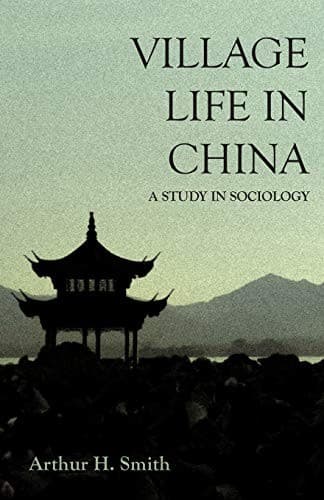
Village Life in China: A Study in SociologySmith, Arthur H.
General
Village Life in China: A Study in Sociology
Smith, Arthur H.
China -- Social life and customs; Villages
Every village being thus surrounded with a ring of markets, each of these
is also a cog in a wheel, playing into other wheels on each side of it.
All those who attend a large market come to have a wide acquaintance with
persons for great distances on each side of them, and the needs of all
persons both buyers and sellers are adequately met.
The word which we have translated "market" (_chi_) denotes merely a
gathering, and another character, (_hui_) is reserved for an assemblage of
a much larger character, which is properly a fair. The number of persons
who attend these fairs frequently rises to between ten and twenty
thousand, giving a stranger the impression that the entire population of
several counties must have been turned loose at once. Fairs are to be
found in the largest Chinese cities, as well as in towns of every grade
down even to small hamlets, though the proportion of towns and villages
which support a fair is always a small one. It appears to be a general
truth that by far the larger part of these large fairs owe their existence
to the managers of some temple. The end in view is the accumulation of a
revenue for the use of the temple, which is accomplished by levying
certain taxes upon the traffic, and by the collection of a ground-rent.
The latter is also a feature of the village market, the proprietor of
each bit of ground appearing at each market to collect of the persons who
have occupied his land, either a fixed amount, or a percentage upon their
sale or supposed sales.
In the larger centres of population, it is common to find fairs held for a
month or more at a time, and in some places there are several of these
fairs every year, forming the centres of activity around which all the
life of the place revolves. In such places the inhabitants make a good
profit by renting buildings to the multitudes who come from a distance to
sell and to buy, and where this is the case, when the fair is not in
operation the city frequently appears to be nearly extinct. But trade no
sooner begins, than countless thousands throng the lately almost deserted
streets.
In order to make a fair a success, it is necessary that the managers
should be men of enterprise and of sufficient business ability to deal
with the many difficulties which are likely to arise. They exercise a
certain supervision over everything, and are technically responsible for
what goes wrong, though this responsibility they frequently evade. In
order to attract a large attendance, it is generally necessary for fairs
which are to last four days, to begin with a theatrical representation,
which continues till the close. Sometimes, however, the players fail to
appear, and in that case the whole fair may come to nothing. These large
fairs are attended by merchants representing cities many hundred miles
distant, and dealing in every article which is likely to attract
customers.
Public-domain text, read in full here on John Shaqi.
Reviews
Reviews
No reviews yet
Be the first to share your thoughts on this work.
Elsewhere in the archive
Join the Discussion
Join the discussion
Sign in to leave a comment or review.
Sign InorCreate an account