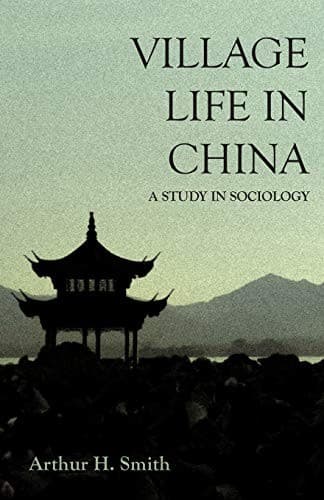
Village Life in China: A Study in SociologySmith, Arthur H.
General
Village Life in China: A Study in Sociology
Smith, Arthur H.
China -- Social life and customs; Villages
Very few farmers have their land all in one plot. A farm of not more than
eighty Chinese acres may consist of from five to fifteen pieces lying on
different sides of the village. And how do you contrive to "watch all
these all night"? you inquire. "Oh we have to go from one to the other,"
you are told. In the case of cotton, the temptation to pick that of others
is absolutely irresistible. The watchman sees some one at the end of the
field meandering slowly along with a basket on his arm, picking cotton as
he goes. The watchman yells, "Who are you?" and the figure moves along a
little faster, but does not stop picking. If he disappears into the patch
of some one else, that is success. But should the watchman become angry,
as he certainly will, and should he pursue, as he is likely to do, and
should he overtake, as is possible, then the trouble begins. Should the
thief not get away in the scuffle, he ought to be taken before the village
headmen and dealt with. If from another village, he probably will be tied
up in the village temple, possibly beaten, and subsequently released upon
payment of a fine. But the real difficulty is that many of the thieves are
from the same village as the owners of the land the products of which they
are appropriating. Not improbably they are "cousins" of the farmer
himself. Perhaps they are his "uncles" or even his "grandfathers." If so,
that complicates matters very much. Chinese ideas of _meum_ and _tuum_ are
to our thought laxity itself under the most favourable conditions. But
these conditions are the most unfavourable. The unity of the family is as
that of a compound individual.
It is to afford some relief from these almost insupportable evils that
societies for watching the crops have originated. They are by no means of
universal occurrence, but like most other Chinese institutions, are to be
met with in some districts, while others immediately adjoining may be
wholly unacquainted with their working. We have known a District
Magistrate in trying a case in which one of the defendants was a
professional watcher of the crops, to be completely mystified by the term
"crop-watcher" which had to be explained to him, as if to a foreigner,
although he was himself a native of an adjacent province.
The villages which have entered into some one of the associations for the
protection of their crops, generally proclaim this fact by painting or
whitewashing upon the side of some conspicuous temple four characters
(_Kung k'an i p'o_,) signifying that the fields are looked after in
common. This proposition embodies a meaning which varies in different
places. Sometimes it denotes that a certain number of persons are on guard
each night, in which case the number (or some number which purports to be
the real one) will perhaps be found posted on a temple wall with a view to
striking awe into intending depredators (in case they should be persons of
education), by showing how numerous are the chances of detection.
Public-domain text, read in full here on John Shaqi.
Reviews
Reviews
No reviews yet
Be the first to share your thoughts on this work.
Elsewhere in the archive
Join the Discussion
Join the discussion
Sign in to leave a comment or review.
Sign InorCreate an account