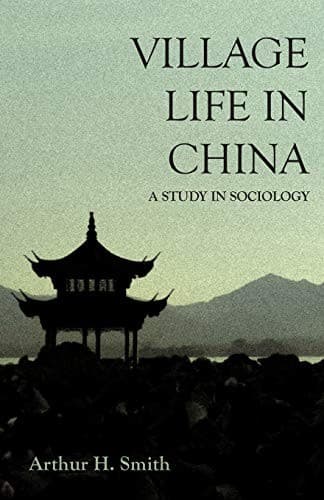
Village Life in China: A Study in SociologySmith, Arthur H.
General
Village Life in China: A Study in Sociology
Smith, Arthur H.
China -- Social life and customs; Villages
The reason for such occurrences, which are of universal notoriety, is not
that the stewards are not able to do that which they are set to do, nor is
the explanation necessarily to be found in their indifference to the
interests of the host. The real seat of the difficulty is, that every
family sufficiently well-to-do to have a large feast is surrounded with a
swarm of poor relatives, who have no other opportunities than these to
make their connection of any service to themselves, and who on such
occasions are determined not to be ignored. A poor family of the same
surname as the host will stand at the door of the mansion where a great
feast is in preparation, with bowls in hand, demanding that a share of the
good things in course of being served shall be apportioned to them. Even
if the master of the house should absolutely refuse his consent, and if
the stewards should follow his directions and give nothing, it would be of
no avail, for the poor family would raise such an uproar as practically to
prevent further proceedings, and all the guests would take the part of the
poor relatives, exhorting the host to give them what they asked.
The habit of levying tribute upon those who happen to be in a position to
pay it, is, as already remarked, deeply rooted in Chinese life. To what
this practice leads, may be seen in the extreme cases of which one now and
then hears, such as the following, detailed to the writer by the principal
sufferer. A man had a dispute with one of his uncles about a tree, the
value of which did not amount to more than a dollar. As he was a person
without force of character, and unable to get his rights, he was obliged
to "eat loss." This enraged his wife to such an extent that she hung
herself. It was now open to her husband to bring a suit at law, accusing
the other party of "harrying to death" (_pi ssŭ_) the deceased wife.
Perhaps this would have been the best plan for the injured husband, but
"peace-talkers" persuaded him to compromise the matter for a money
payment. The other party had a powerful advocate in a relative who was a
notorious blackleg, expert in lawsuits, and who freely gave his advice.
Even under these advantages, the middlemen into whose hands the matter was
put, decided that the uncle should pay 30,000 cash to the family of the
woman, as a contribution to the funeral, which was done.
Public-domain text, read in full here on John Shaqi.
Reviews
Reviews
No reviews yet
Be the first to share your thoughts on this work.
Elsewhere in the archive
Join the Discussion
Join the discussion
Sign in to leave a comment or review.
Sign InorCreate an account