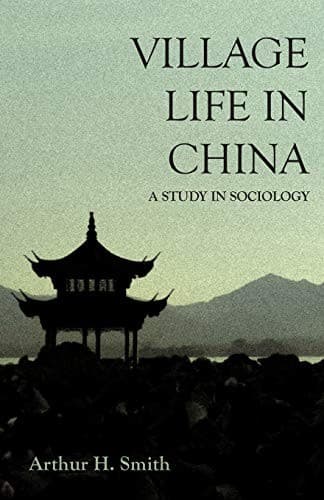
Village Life in China: A Study in SociologySmith, Arthur H.
General
Village Life in China: A Study in Sociology
Smith, Arthur H.
China -- Social life and customs; Villages
The strain upon the exiguous resources of a single courtyard or set of
yards in preparing food simultaneously for the guests, often numbering
hundreds, is very great; yet the inevitable waiting, the crowding, the
turmoil, and discomfort are all borne without a tenth of the complaint and
resentment which a tithe of the same annoyances and provocations would
probably cause the readers of these lines. In China there is no other way
to bury the dead, and there never has been any other way. Ceremony is the
very life of the Chinese race, and on no other occasion is ceremony so
triumphantly tyrannical as at a Chinese funeral. Yet in the most showy
pageantry there is likely to be an element of unutterable shabbiness. In
city processions flags, banners, umbrellas, screens, and handsome wooden
tablets shining with lacquer and glittering with gilt are carried in great
numbers before and behind the coffin of notables, but the bearers are not
infrequently dirty, ragged beggars, straggling along without aim and
without order. Little or nothing of this is to be seen in the rural
districts, but the confusion and disorderliness are omnipresent and
inevitable. There is in the Chinese language no word meaning solemn, for
there is no such thing as solemnity in the Chinese Empire.
White being the mourning colour, at a funeral swarms of people appear,
some with a mere fillet about their head, others with square caps, and
others with a more abundant display, up to those whose near relationship
to the deceased requires that they be covered entirely with the coarse
cloth which denotes the deepest depth of mourning, their feeble steps
being supported by a short stick of willow upon which they ostentatiously
lean, particularly at the numerous junctures when wailing is to take
place. Generally speaking, the wearers of white are those who come within
the "Five Degrees of Relationship" (wu fu), that is, all directly
descended from one's grandfather's grandfather (the steps being indicated
in Chinese by separate names for each generation, to wit, _kao_, _tsêng_,
_tsu_, _fu_, and _shên_, viz., three generations of "grandfathers," my
father, and myself). The family in mourning furnishes material for all the
cloud of mourners, but if the married daughters are provided by their
husband's family with a supply, this is a mark of special honour.
Sometimes women are seen proudly carrying a huge bolt of wholly
superfluous cloth on their arm all through a funeral, furnishing a public
testimonial that their husbands or fathers-in-law have done the correct
thing, thus giving the daughter-in-law a large supply of "face."
Public-domain text, read in full here on John Shaqi.
Reviews
Reviews
No reviews yet
Be the first to share your thoughts on this work.
Elsewhere in the archive
Join the Discussion
Join the discussion
Sign in to leave a comment or review.
Sign InorCreate an account