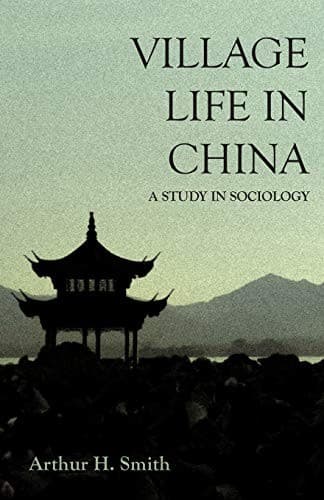
Village Life in China: A Study in SociologySmith, Arthur H.
General
Village Life in China: A Study in Sociology
Smith, Arthur H.
China -- Social life and customs; Villages
If the foreigner who has lived in China long enough to take in its
external phenomena, but not long enough to perceive the causes of them,
were to explain to one of less knowledge his views as to the leading
features of the change from one Chinese year to another as exhibited in
the life of the Chinese, he would probably name (and with much
plausibility) one or more of the following particulars.
DUMPLINGS
The customs of different parts of the wide empire doubtless vary, but
probably there is no part of it in which either dumplings or some similar
article are not inseparably associated with New Year's Day, in the same
way as plum-pudding with an English Christmas, or roast-turkey and mince
pie with a New England Thanksgiving. As compared with Western peoples the
number of Chinese who are not obliged to practice self-denial either in
the quantity or the quality of their food, and in both, is small. The diet
of the vast mass of the nation is systematically and necessarily
abstemious. Even in the case of farmers' families who are well enough off
to afford the year round good food in abundance, we do not often see them
indulging in such luxury. Or if the males of the elder generation indulge,
the women and children of a younger generation are not allowed to do so.
Hereditary economy in the item of food is a marked Chinese trait. To "eat
good things" is a common phrase denoting the occurrence of a wedding, a
funeral, or some occasion upon which "good things" cannot be dispensed
with. To eat cakes of ordinary grain on New Year's Day, and not to get
any dumplings at all, is proverbially worse than not to have any New Year.
Moreover, the keen joy with which every member of a Chinese family looks
forward to the dietetic aspect of their New Year, the still keener joy
with which every member is absorbed in devouring all he can get of the
best there is to be got, and the scarcely less keen joy with which each
one recalls the details of the menu when the family is once more launched
upon the Sahara of ordinary fare--these are full of suggestion and
instruction to Occidentals who habitually have so much to eat that they
seldom secure the best sauce of gnawing hunger, and are more likely than
not to be bored by being asked out to an elaborate dinner with many
courses. The most robust imagination finds it impossible to conceive of a
Chinese who should take this view of what always appeals to the finest
feelings of his nature. There is therefore much reason in placing
Dumplings in the forefront of a Chinese New Year.
REUNION
Public-domain text, read in full here on John Shaqi.
Reviews
Reviews
No reviews yet
Be the first to share your thoughts on this work.
Elsewhere in the archive
Join the Discussion
Join the discussion
Sign in to leave a comment or review.
Sign InorCreate an account