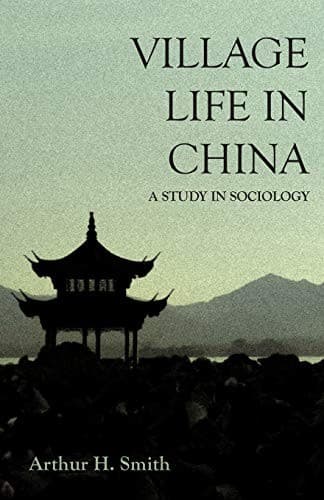
Village Life in China: A Study in SociologySmith, Arthur H.
General
Village Life in China: A Study in Sociology
Smith, Arthur H.
China -- Social life and customs; Villages
It is a venerable maxim that "Satan finds some mischief still, for idle
hands to do." Probably no race that ever lived could resist the strain of
such a sudden transition from constant industrial activity, to complete
industrial inactivity, to be followed half a month later by the old
routine and another year of bondage. They could not resist the strain,
that is to say, without a corresponding reaction; neither can the Chinese.
It is not in human nature to find consecutive enjoyment merely in the
directions which have been named, without trying to go farther and to get
more. This is precisely what the Chinese do, and they do it by the
excitement of gambling. This, with opium smoking, is the greatest vice in
China, and the most ruinous. But after all, taking the country districts
through, the proportion of gamblers among the working classes, so far as
we are aware, is limited, though vast sums are everywhere annually
squandered in this way. But the remarkable thing is that at New Year's
time all restrictions seem to be removed, and both men and women give
themselves up to the absorbing excitement of cards, dominoes, etc., with
money stakes of varying amount, and with no fear or even thought of future
evil harvests. In the abstract, gambling is of course recognized as wrong
and not to be indulged, as likely to lead to trouble. But at New Year's
time "everybody does it," "it is only for amusement," and "there is
nothing else to do,"--the latter an important fact to be taken account of
at a time when even cooking is often prætermitted as much as possible.
Merchants do not take down their shutters, but one can hear the clerks
noisily gambling inside. Innkeepers will not open their front doors, but
landlord and servants are all gambling together and will refuse to stop a
game to feed your animals or get you a meal, telling you that it is no
time to travel, and that business is business, and amusement amusement.
Old women and young women squatted on their mats or their _k'angs_,
feverishly shuffle their cards and pay their little stakes, and all are
having a good time.
That this state of things will not stop suddenly on the day after the
Feast of Lanterns, is obvious. It often never stops at all, but goes on
with a widening and lengthening trail of ruin, not ending even with the
grave, but lasting to the third and fourth generation. Surely we are right
in calling gambling a leading feature of a Chinese New Year. And yet after
all, perhaps we have not got to the bottom of the matter.
DEBT-PAYING
Public-domain text, read in full here on John Shaqi.
Reviews
Reviews
No reviews yet
Be the first to share your thoughts on this work.
Elsewhere in the archive
Join the Discussion
Join the discussion
Sign in to leave a comment or review.
Sign InorCreate an account