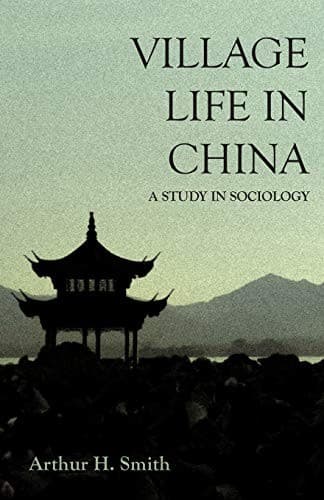
Village Life in China: A Study in SociologySmith, Arthur H.
General
Village Life in China: A Study in Sociology
Smith, Arthur H.
China -- Social life and customs; Villages
2. _Everybody is obliged to lend money._ We have just remarked that the
man who happens to have a little surplus cash does not like to lend it,
lest he should never see it again. But there are various kinds and degrees
of pressure which can be brought to bear upon the capitalist. One of these
is connected with the solidarity of the Chinese family, or clan. If one of
the members has money which he might lend and another is desperately in
need of it, the latter will get a member of the generation higher than
that to which the capitalist belongs, to intercede for him. This may be
done unwillingly, but it will probably be done. To a sufficient amount of
pressure of this ancestral description, the capitalist will find it best
to yield, though not improbably against his financial judgment. But every
Chinese is from infancy accustomed to the idea that it is seldom easy to
have one's own way in all things, and that when one cannot do as he would,
he must do as he must. If the borrower does not belong to the same family
or clan as the lender, the difficulty will be greater, but it may perhaps
be overcome by the same description of pressure, by means of friends. A
would-be borrower is often obliged to make a great many kotows before he
can secure the favour of a loan (at an extortionately high rate of
interest), but he is much aided in his efforts by the Chinese notion that
when a certain amount of pressure has been brought to bear, a request
_must_ be granted, just as one of a pair of scales must go down if you put
on enough weights. Thus it comes about that in all ranks of Chinese, the
man who has, is the man who must be content to allow to share in his
wealth (for a handsome remuneration).
3. From the foregoing propositions, it follows with inevitable certainty,
that _almost everybody owes some one else_. There is never any occasion to
ask a Chinese whether he owes money. The proper formula is, How much do
you owe, and to whom, and what is the rate of interest?
4. _No Chinese ever pays cash down, unless he is obliged to do so._ To us
this may appear a most eccentric habit, but it seems to be almost a law.
The Chinese has learned by ages of experience, that he no sooner pays away
money to satisfy one debt, than he needs that same money to liquidate
other debts. In their own figuratively expressive phrase, a single cup of
water is wanted in three or four places at once, and the supply is always
as inadequate, as the classical "cup of water to put out the fire in a
cart-load of fuel." Knowing this with a keenness of apprehension which it
is difficult for us to appreciate, the Chinese holds on fast to his cash
till it is wrung from him by a force which overcomes his own tenacity of
grip.
Public-domain text, read in full here on John Shaqi.
Reviews
Reviews
No reviews yet
Be the first to share your thoughts on this work.
Elsewhere in the archive
Join the Discussion
Join the discussion
Sign in to leave a comment or review.
Sign InorCreate an account