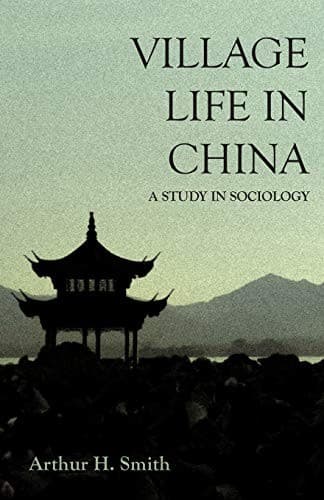
Village Life in China: A Study in SociologySmith, Arthur H.
General
Village Life in China: A Study in Sociology
Smith, Arthur H.
China -- Social life and customs; Villages
The writer once counted twenty-four such nests in a single moderate sized
elm, and this in the suburbs of a Chinese city. Buddhist teachings in
regard to the sacredness of animal life do not suffice to account for the
singular inviolability which crows' nests enjoy in China. In the spring
they are sometimes defended with the query; "How would you like to have
your house pulled down?" But in a region where every stick of fuel is
precious, what sacredness can attach to a bushel or two of large twigs,
when the crows have visibly done using them? Neither does superstition in
regard to ill-luck arising from demolition of the nests of crows explain
their security, although at first sight this may seem to be the case.
Extensive inquiries have satisfied us that the true explanation is simply
the natural one, that the Chinese boy is _afraid_ to climb so high as a
crow's-nest. "What if he should fall?" says every one when applied to for
information on the point, and it is this unanswered and unanswerable
question which seems to protect young Chinese crows from age to age.
The Chinese boy can seldom get access to running water; that is to say,
the proportion of Chinese who can do so is infinitesimal. Most of them
have no lakes, rivers, or ponds in which they can plunge and learn to
swim, or in which they can fish. The village mud-hole is the nearest
approach to the joys of a "watering-place" to which Chinese children can
ordinarily aspire. These excavations are the hole whence the material for
the village houses was originally dug. During the summer time these pits,
many of them as large as a dry-dock, are filled to the brim with dirty
water, and at such times they are sure to be surrounded by groups of
children clad in the costume of the garden of Eden, enjoying one of the
few luxuries of their mundane existence. When the boys are too large to
indulge in this amusement, there is much reason to fear that most of them
have taken their last bath, no matter to what age their lives may be
prolonged!
[Illustration: CHINESE PUNCH AND JUDY.]
[Illustration: THE VILLAGE STORY-TELLER.]
If he cannot fish, neither can the Chinese boy go a-hunting, for in the
most populous parts of the plains, of which so large a portion of the
empire is composed, there is nothing to hunt. A few small birds, and the
common hare, seem to constitute the objects most frequently shot, but
except in the case of the limited number of those who make a business of
securing such game to sell as a means of support, there are very few
persons who devote their energies to any form of hunting. Indeed, the
instinct which is said to lead the average Englishman to remark "It is a
fine day, let us go and kill something," is totally lacking in the
Chinese.
Public-domain text, read in full here on John Shaqi.
Reviews
Reviews
No reviews yet
Be the first to share your thoughts on this work.
Elsewhere in the archive
Join the Discussion
Join the discussion
Sign in to leave a comment or review.
Sign InorCreate an account