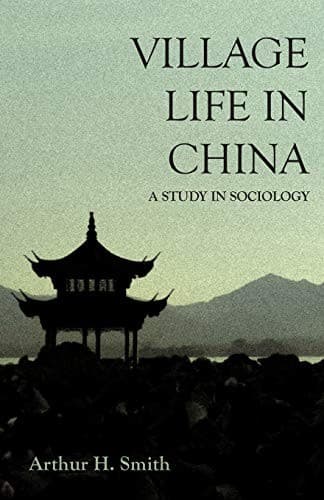
Village Life in China: A Study in SociologySmith, Arthur H.
General
Village Life in China: A Study in Sociology
Smith, Arthur H.
China -- Social life and customs; Villages
In the midst of such a barren wilderness as constitutes the life of most
Chinese children, anything which breaks the dull monotony is welcomed with
keen joy. The feast-days, the annual or semiannual fairs held at some
neighbouring town, an occasional theatrical exhibition, the humbler Punch
and Judy performance, the peripatetic story-teller, the unfailing
succession of weddings and funerals, and most of all the half-month
holiday at New Year all serve as happy reliefs to the unceasing grind of
daily toil.
There is one incident in the life of the Chinese lad, which assumes in his
eyes some degree of importance, to which most Occidental boys are
strangers. This is the ceremony of donning the cap, in other words of
becoming a man and his marriage. The age at which this takes place is far
from being a fixed one, but is often in the vicinity of sixteen. The
customs observed vary widely, in some rural districts they frequently
consist in nothing more exciting than the playing by a band of music in
the evening before his marriage, and a visit on the part of the young man
to each house in the village where he makes his prostration, much as at
New Year, and is henceforth to be considered a full-grown man, and is
protected to some extent from snubs because he is "only a child."
The more conspicuous part of the affair, however, is the wedding. This
proceeding is based upon principles so radically different from those to
which we are accustomed, that it is generally hard for a Westerner to
become reconciled either to the Chinese theory or to the practice. To us,
marriage seems suitable for persons who have attained, not merely years of
puberty, but a certain maturity of development compatible with the new
relations which they now assume. We regard the man and wife as the basis
and centre of a new family, and there is ancient and adequate authority
for the doctrine that they should leave father and mother. In China it is
altogether otherwise. The boy and girl who are married are not a new
family, but the latest branch in a tall family tree, independent of which
they have no corporate existence.
Public-domain text, read in full here on John Shaqi.
Reviews
Reviews
No reviews yet
Be the first to share your thoughts on this work.
Elsewhere in the archive
Join the Discussion
Join the discussion
Sign in to leave a comment or review.
Sign InorCreate an account