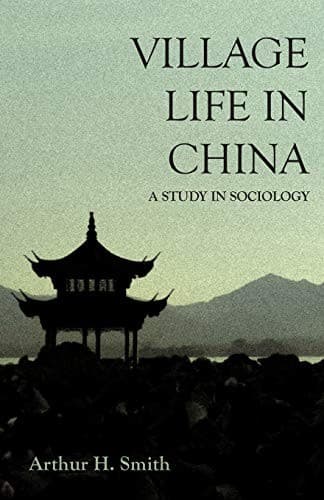
Village Life in China: A Study in SociologySmith, Arthur H.
General
Village Life in China: A Study in Sociology
Smith, Arthur H.
China -- Social life and customs; Villages
There is a story of a certain noble English lord, who had more daughters
than any other member of the aristocracy. When on the Continent
travelling, he walked out one day with six of his daughters. Some one who
saw him, remarked to a companion, "Poor man." The noble lord overheard the
observation, and turning to the person who made it, replied, "Not so
'poor' as you think; I have six more at home!" It is questionable whether
any Chinese could be found who would not sympathize with the comment of
the bystander, or who would agree with the reply of the father. Indeed, we
have serious doubts whether, among all the innumerable myriads of this
race, there ever lived a Chinese who had twelve daughters living at once.
It is one of the postulates of Chinese propriety that however much a wife
may continue to visit at the maternal home, (and on this point the usages
in some regions are very liberal), her children must all be born at their
father's house. This is a rule of such unbending rigour that a breach of
it is considered a deep disgrace, and in the effort to avoid it women will
sometimes submit to extreme inconveniences, and run the most serious
risks, not infrequently, it is said, meeting in consequence with painful
and humiliating accidents. To the Occidental question as to the reason for
this powerful prejudice against a confinement at a mother's home, the
Chinese are able to give no better reply than an affirmation that, if such
an event should happen, the mother's family may be expected to become very
poor. This superstition is so strong that in some localities, if such an
event has happened, it is customary for the family of the husband to
harness a team to a plough, and, proceeding to the home of the girl's
parents, plough up their courtyard. The son-in-law must also cook a kettle
full of millet or rice for his mother-in-law, by which means the dire
extremity of poverty may be avoided. Perhaps, after all, the idea at the
bottom of these singular performances is merely the thoroughly Chinese one
that, if a married daughter and her children are to come upon her mother's
family for their support, poverty will be the certain result, a view which
has in it some reason.
A description of the ceremonious superstitions common among the Chinese on
occasion of the birth of a child, especially of a son, and most especially
of a firstborn son, would fill a volume. These are far more rigorously
observed in the southern part of the empire than at the north, and more in
cities than in the country village, where many of these customs may be
wholly unknown.
Public-domain text, read in full here on John Shaqi.
Reviews
Reviews
No reviews yet
Be the first to share your thoughts on this work.
Elsewhere in the archive
Join the Discussion
Join the discussion
Sign in to leave a comment or review.
Sign InorCreate an account