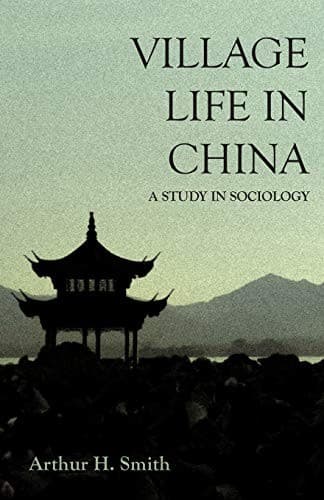
Village Life in China: A Study in SociologySmith, Arthur H.
General
Village Life in China: A Study in Sociology
Smith, Arthur H.
China -- Social life and customs; Villages
The preparation of this indispensable staple for use occupies the hands of
millions of Chinese women, from its collection in the field--a most
laborious work since the plant grows so low--to its appearance as
garments, and its final disappearance as flat padding to be used in
shoe-soles. The ginning, the "scutching" or separation of fibres, the
spinning, the cording, the winding and starching, and especially the
weaving are all hard and tiresome work, and that too without end in sight
while life lasts. In some regions every family owns a loom (one of the
clumsy machines exiled from the West a century ago) and it is not uncommon
for the members of a family to take turns, the husband weaving until
midnight, when the wife takes up the task till daylight, (often in cellars
two-thirds underground, damp, unventilated, and unwholesome). Even so it
is frequently difficult to keep the wolf away from the door. Within the
past few years the competition of machine twisted cotton yarns is severely
felt in the cotton regions of China, and many who just managed to exist in
former days are now perpetually on the edge of starvation. This is the
"seamy side" of "progress."
The fact that Chinese girls are married so young, and that they have not
been taught those lessons of self-control which it is so important for
them to learn, suffices to demonstrate the absolute necessity for the
existence of the Chinese mother-in-law as an element in the family. A
Chinese married woman must address her mother-in-law as "mother," but for
precision is allowed to refer to her as "mother-in-law mother." A Chinese
woman calling on a foreign lady asked the latter (in the presence of her
husband) about her family in the homeland. The lady mentioned that she had
"a mother-in-law," upon which the Chinese woman in an awed whisper
pointing to the foreign gentleman, inquired: "_Won't he beat you for
saying that?_"
A great deal is heard of the tyranny and cruelty of these mothers-in-law,
and there is a firm basis of fact for all that is so often said upon that
point. But it must at the same time be borne in mind that without her the
Chinese family would go to utter ruin. The father-in-law is not only
unfitted to take the control which belongs to his wife, even were he at
home all the time which would seldom be the case, but propriety forbids
him to do any such thing, even were he able. In families where a
mother-in-law is lacking, there are not unlikely to be much greater evils
than the worst mother-in-law. Abuse of the daughter-in-law is so common a
circumstance, that unless it be especially flagrant, it attracts very
little attention.
Public-domain text, read in full here on John Shaqi.
Reviews
Reviews
No reviews yet
Be the first to share your thoughts on this work.
Elsewhere in the archive
Join the Discussion
Join the discussion
Sign in to leave a comment or review.
Sign InorCreate an account