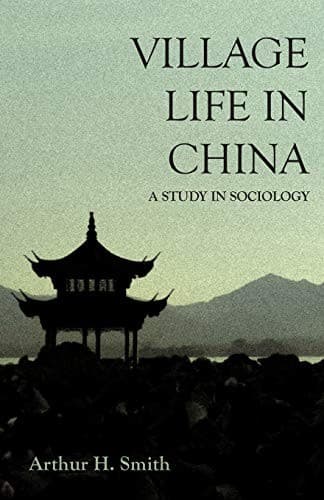
Village Life in China: A Study in SociologySmith, Arthur H.
General
Village Life in China: A Study in Sociology
Smith, Arthur H.
China -- Social life and customs; Villages
A traveller through China often notices in the villages along his route
that in the early morning most of the men seem to be assembled by the
roadside, each one squatting in front of his own door, all busily engaged
in shovelling in their food with chopsticks (appropriately called
"nimble-sons"), chatting meantime during the brief intervals with the
neighbour nearest. That the entire family should sit down to a table,
eating together and waiting for one another, after the manner of the
inhabitants of Western lands, is an idea so foreign to the ordinary
Chinese mind as to be almost incomprehensible.
This Chinese (and Oriental) habit is at once typical and suggestive. It
marks a wholly different conception of the family, and of the position of
woman therein, from that to which we are accustomed. It indicates the view
that while man is _yang_, the male, ruling, and chief element in the
universe, woman is _yin_, "dull, female, inferior." The conception of
woman as man's companion is in China almost totally lacking, for woman is
not the companion of man, and with society on its present terms she never
can be. A new bride introduced into a family has visible relations with no
one less than with her "husband." He would be ashamed to be seen talking
with her, and in general they seem in that line to have very little to be
ashamed of. In those unique instances in which the young couple have the
good sense to get acquainted with each other, and present the appearance
of actually exchanging ideas, this circumstance is the joke of the whole
family circle, and an insoluble enigma to all its members. We have heard
of cases in which members of a family where there was a newly married
couple, kept a string in which was tied a knot, every time that they were
heard to speak to one another. This cord would be subsequently exhibited
to them in ridicule of their intimacy!
A Chinese bride has no rational prospect of happiness in her new home,
though she may be well dressed, well fed, and perhaps not abused. She must
expect chronic repression through the long years during which she is for a
time in fact, and in theory always, a "child." Such rigorous discipline
may be necessary to fit her for the duties of her position, when she shall
have become herself a mother-in-law, and at the head of a company of
daughters-in-law, but it is a hard necessity. That there are sometimes
genuine attachments between mothers-in-law and daughters-in-law it would
be a mistake to deny, for in such rare cases human nature shows its power
of rising superior to the conventional trammels in which it finds itself
by iron customs bound.
Public-domain text, read in full here on John Shaqi.
Reviews
Reviews
No reviews yet
Be the first to share your thoughts on this work.
Elsewhere in the archive
Join the Discussion
Join the discussion
Sign in to leave a comment or review.
Sign InorCreate an account