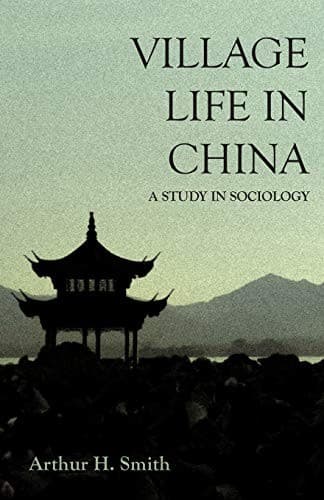
Village Life in China: A Study in SociologySmith, Arthur H.
General
Village Life in China: A Study in Sociology
Smith, Arthur H.
China -- Social life and customs; Villages
If a Chinese woman has the heaven-bestowed gift of being obstreperous to
such a degree that, as the sayings go, "people do not know east from
west"; that "men are worn out and horses exhausted"; that "the mountains
tremble and the earth shakes," this is unquestionably her surest
life-preserver. It is analagous to the South American toucan, which is
said to frighten away enemies by the mere exhibition of itself, they not
caring to wait for further and detailed proofs of its capacities of
execution. But if such an endowment has been denied her, her next best
resource is to pursue a course exactly the opposite, in all circumstances
and under all provocations _holding her tongue_. To most Chinese women,
this seems to be a feat as difficult as aërial navigation, but now and
then an isolated case shows that the difficult is not always the
impossible.
The present position of woman in China is a heritage of the remote past,
as is illustrated by the most ancient Chinese literature, an example of
which heads the present chapter. The instructions and the prohibitions in
the Book of Rites, one of the oldest and most venerated classical works,
embody fundamental principles which have always governed the Chinese in
their treatment of women. The essence of the Chinese classical teaching on
this subject is, that woman is as inferior to man as the earth is inferior
to heaven; and that she can never attain to full equality with man.
According to Chinese philosophy death and evil have their origin in the
_Yin_, or female principle of Chinese dualism, while life and prosperity
come from the subjection of it to the _Yang_, or male principle; hence it
is regarded as a law of nature to keep woman completely under the power of
man, and to allow her no will of her own. The result of this theory and
the corresponding practice is that the ideal for women is not development
and cultivation, but submission. Women can have no happiness of their own,
but must live and work for men, the only practical escape from this
degradation being found in becoming the mother of a son. Woman is bound by
the same laws of existence in the other world. She belongs to the same
husband, and is dependent for her happiness on the sacrifices offered by
her descendants.[5]
Public-domain text, read in full here on John Shaqi.
Reviews
Reviews
No reviews yet
Be the first to share your thoughts on this work.
Elsewhere in the archive
Join the Discussion
Join the discussion
Sign in to leave a comment or review.
Sign InorCreate an account