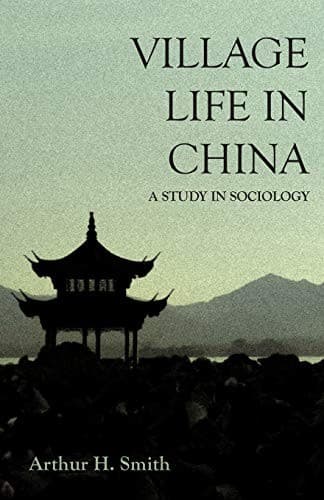
Village Life in China: A Study in SociologySmith, Arthur H.
General
Village Life in China: A Study in Sociology
Smith, Arthur H.
China -- Social life and customs; Villages
To give a correct diagnosis of the inner causes of the disunity of Chinese
social and family life without at the same time grossly misrepresenting
both the Chinese character and society, is a hopeless undertaking. Merely
to note even the most authentic and typical facts is to convey an
impression which is incorrect because it is not proportional. Every family
contains within itself the seeds of disunity, and if they do not in all
cases produce their appropriate harvest, it is because they are mercifully
blighted or counteracted in their development.
Of each Chinese family a full half has had or will have interests largely
at variance with those of the other half. Every Chinese wife came by no
choice of her own from some other family, being suddenly and irrevocably
grafted as a wild stock upon the family tree of her husband. As we have
already seen, she is not received with enthusiasm, much less with
affection (the very idea of which in such a connection never enters any
Chinese mind) but at best with mild toleration, and not infrequently with
aggressive criticism. She forms a link with another set of interests from
which by disruption she has indeed been dissevered, but where her
attachments are centred. The affection of most Chinese children for their
mothers is very real and lasting. The death of the mother is for a
daughter especially the greatest of earthly calamities. Filial piety in
its cruder and more practical aspects constantly leads the married
daughter to wish to transfer some of the property of the husband's family
to that of her mother. The temptation to do so is often irresistible, and
sometimes continues through life, albeit with many dramatic checks. The
Chinese speak of this habit in metaphorical phrase as "a leak at the
bottom" which is proverbially hard to stop. It is a current saying that of
ten married daughters, nine pilfer more or less. It is not uncommon to
hear this practice assigned as one of the means by which a family is
reduced to the verge of poverty. The writer once had occasion to acquaint
a Chinese friend with the fact that a connection by marriage had recently
died. He replied thoughtfully: "It is well she is dead; she was
gluttonous, she was lazy; and beside she stole things for her mother!"
Public-domain text, read in full here on John Shaqi.
Reviews
Reviews
No reviews yet
Be the first to share your thoughts on this work.
Elsewhere in the archive
Join the Discussion
Join the discussion
Sign in to leave a comment or review.
Sign InorCreate an account