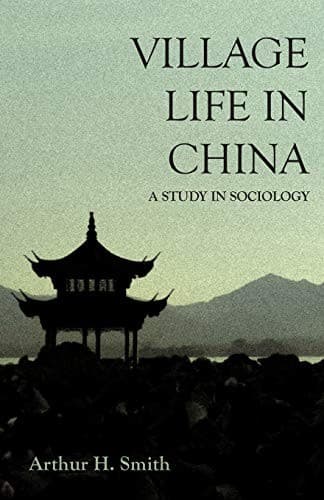
Village Life in China: A Study in SociologySmith, Arthur H.
General
Village Life in China: A Study in Sociology
Smith, Arthur H.
China -- Social life and customs; Villages
Mencius remarked that the feeling of pity is common to all men, and what
was true in his day is no less so now. At the same time there are wide
differences in its exhibition. Every Chinese is a seasoned soldier in the
warfare of life and is accustomed to every form and grade of misery. His
first thought at such a spectacle is not, Cannot something be done about
it? but if he has a thought at all it is far more likely to be, Why should
I do anything about it? Ages of hereditary experience have taught him not
too rashly to indulge in sentimental benevolence which may have
disagreeable sequelæ. A Chinese remarked in the writer's hearing while
glancing at the corpse of a man who had died far from home under painful
circumstances: "This plaything will be hard to transport." Of what we call
sympathy he had not the smallest conception. A few years later this same
individual was seized by the District Magistrate of the county in which he
lived, thrust into the standing-cage (a punishment far more horrible than
the slicing process, since the victim is conscious but is in a position of
acute agony without food or water until he miserably perishes) with no
definite charge of any kind against him, and with no trial whatever. The
only comment of many of these who had once known him well, was either that
it was just what might have been expected, or that it was probably just
what he deserved.
The typical Chinese is a good-natured, even-tempered, peaceable
individual, ready to do his part in life without shirking, and asking only
for fair treatment. But as the placid surface of many lakes is often
lashed into fury by sudden and violent winds pouring down through mountain
gorges, so the equilibrium of the Chinese is liable to be destroyed by
gusts of terrible passion, instantly transforming him from a quiet member
of a well ordered society, into an impressive object-lesson on the reality
of demon possession. Whether life is worth living has been thought "to
depend upon the liver." In China one might rather affirm that it hinges
upon the spleen. Some of our readers may not be unfamiliar with a legend
of a distinguished American who was provided by his kind father with a
little hatchet which he tried upon a favourite cherry tree with marked
success. When the father discovers this, he asks who did the deed, upon
which the child handsomely confesses, and is clasped to his father's arms
with the remark that he would rather lose many cherry trees than to have
his son tell a lie. The whole occurrence probably did not consume more
than ten minutes. To illustrate some of the traits of disunity already
mentioned, let us translate this incident into Chinese.
Public-domain text, read in full here on John Shaqi.
Reviews
Reviews
No reviews yet
Be the first to share your thoughts on this work.
Elsewhere in the archive
Join the Discussion
Join the discussion
Sign in to leave a comment or review.
Sign InorCreate an account