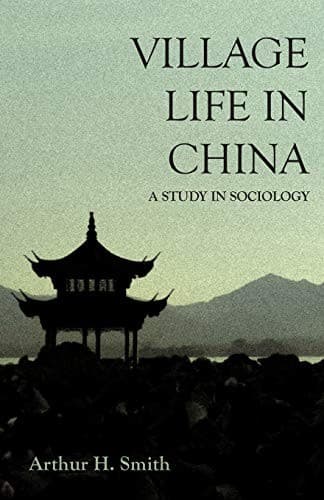
Village Life in China: A Study in SociologySmith, Arthur H.
General
Village Life in China: A Study in Sociology
Smith, Arthur H.
China -- Social life and customs; Villages
The Chinese character often abounds in amiable alleviations of conditions
which would seem at first sight to make existence intolerable. In the
breasts of the Chinese, as in ours, Hope springs eternal. His
generalizations from the experience of others as well as his own, render
him measurably certain that in the long-run almost nothing will go right.
He expects to meet insincerity, suspicion, and neglect, and he is rarely
disappointed. He will often be dependent upon those who would be glad to
get rid of him, and who keep him constantly aware of this fact. He knows
as certainly before as after the event that the loans which he is obliged
to make will not be repaid at the proper time, nor in full; that the
promised assistance if given at all will be rendered grudgingly, and
perhaps turned into open hostility. It is proverbial that he has in his
mind "two hundred next years" but he is not infrequently perfectly aware
that no number of "next years" will ever suffice to get him straight with
the world. Yet amid all this he generally maintains a serene cheerfulness
which to us would be as impossible as comfortable respiration in the foul
atmosphere of a Chinese sleeping-room. He is used to it--we are not. A man
of this type weighted with a termagant wife, who had become exasperated by
the unexpected remarriage of a brother of her husband for twenty years a
widower, and who filled the house with a tempest in consequence, said to
the writer that for the past three months he had not drawn "one peaceful
breath!" This was not mentioned by way of complaint, but as one might
refer in reply to an inquiry about a troublesome corn on the toe. Under
stress of this sort many Chinese exhibit a degree of forbearance to which
it is to be feared we have no counterpart in the West, where individual
rights have not for ages been merged in those of the family. Such persons
are said to "eat a dumb man's injury," and the number of them is
proverbially unlimited, for the class is immortal.
No one who is intimately acquainted with their real life is likely to
exaggerate the evils from which the Chinese suffer, since the strongest
representation often seems to come short of the truth. But every one finds
himself asking by what means it would be possible to forefend some of
these evils. Since many of them appear to be inseparably associated with
that poverty which is apparently the keynote of Chinese discords, one is
tempted to imagine that if poverty were abolished, family disunity also
would largely disappear. Something may be said in favour of this theory,
but it fails in presence of the undoubted fact that the evils to be
remedied are perhaps quite as prevalent among those Chinese who are fairly
well off, as among the poor, besides being much more conspicuous and
irrepressible.
Public-domain text, read in full here on John Shaqi.
Reviews
Reviews
No reviews yet
Be the first to share your thoughts on this work.
Elsewhere in the archive
Join the Discussion
Join the discussion
Sign in to leave a comment or review.
Sign InorCreate an account