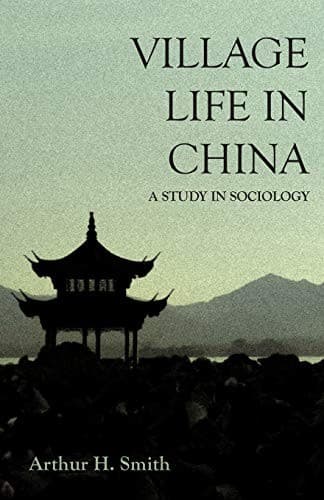
Village Life in China: A Study in SociologySmith, Arthur H.
General
Village Life in China: A Study in Sociology
Smith, Arthur H.
China -- Social life and customs; Villages
How long it will take Christianity to renovate an empire like China, is a
question which may be answered in different ways, but only hypothetically.
First by historical analogies. It took eight centuries to develop the
Roman Empire. It has taken about as long to mold Saxon, Danish, and Norman
elements into the England of to-day. Each of these race-stocks were at the
start barbarous. The Chinese are an ancient and a highly civilized race, a
fact which may be in some respects a help in their Christianization, and
in others a hindrance. Taking into account the intensity of Chinese
prejudices, the strength of Chinese conservatism, the vast numbers
involved and their compact, patriarchal life, we should expect the first
steps to be very slow. Reckoning from the general opening of China in
1860, fifty years would suffice for a good beginning, three hundred for a
general diffusion of Christianity, and five hundred for its obvious
superseding of all rival faiths. Reasoning from history and psychology
this is perhaps a probable rate of progress, and its realization would be
a great result.
There is however a different sort of forecast which appeals to many minds
more powerfully. It must be remembered that spiritual development, like
that of races, is slow in its inception, but once begun it takes little
account of the rules of ratio and proportion. The intellectual, moral, and
spiritual forces of Christianity are now far greater than they have ever
been before. The world is visibly contracted. The life of the man of
to-day is that of "a condensed Methusaleh." The nineteenth century
outranks the previous millennium. Great material forces are but types and
handmaids of the great spiritual forces which may be reinforced and
multiplied--as they have been at certain periods of the past--to a degree
at the present little anticipated.
Putting aside all consideration of the time element, we consider it
certain that what Christianity has done for us it will do for the Chinese,
and under conditions far more favourable, by reason of the high
vitalization of the age in which we live, its unfettered communication,
and the rapid transfusion of intellectual and spiritual forces. The
forecast of results like these is no longer the iridescent dream which it
once appeared. It is sober history rationally interpreted. When
Christianity shall have had opportunity to work out its full effects, it
will be perceived to have been pervasive leaven in the individual heart,
in society, and in the world. Whether it is to take five centuries or
fifty to produce these results appears to be a matter of altogether minor
importance in view of certain success in the end.
There are in China many questions and many problems, but the one great
question, the sole all-comprehending problem is how to set Christianity at
work upon them, which alone in time can and will solve them all.
END
Index
Abacus, Chinese, 105.
Abdomen, the seat of intellect, 85.
Public-domain text, read in full here on John Shaqi.
Reviews
Reviews
No reviews yet
Be the first to share your thoughts on this work.
Elsewhere in the archive
Join the Discussion
Join the discussion
Sign in to leave a comment or review.
Sign InorCreate an account