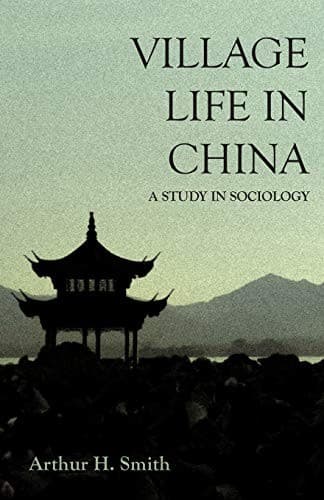
Village Life in China: A Study in SociologySmith, Arthur H.
General
Village Life in China: A Study in Sociology
Smith, Arthur H.
China -- Social life and customs; Villages
So much confinement, and such close application from the very earliest
years, can scarcely fail to show their effects in his physical
constitution. His brother hoes the ground, bare-headed throughout the
blistering heats of July, but such exposure to the sun would soon give him
the headache. His brother works with more or less energy all day long
(with intermittent sequence), but were _he_ compelled to do the same the
result would not improbably be that he would soon begin to spit blood.
That he is physically by no means so strong as he once was, is undeniable.
He has very little opportunity to learn anything of practical affairs,
and still less disposition. The fact that a student has no time to devote
to ordinary affairs is not so much the reason of his ignorance, as is the
fact that for him to do common things is not respectable. Among the four
classes of mankind, scholars rank first, farmers, labourers, and merchants
being at a great remove.
The two things that a pupil is sure to learn in a Chinese school are
obedience, and the habit of concentrating his attention upon whatever he
is reading, to the entire disregard of surrounding distractions. So far as
they go these are valuable acquirements, although they can scarcely be
termed an education.
Every pupil is naturally anxious to get into the class of scholars, and
this he does as soon as he gives all his time to study; for whether he is
a real scholar or not, he plainly belongs to neither of the other classes.
We are told in the Confucian Analects that the master said, "The
accomplished scholar is not a utensil." The commentators tell us that this
means that whereas a utensil can only be put to one use, the accomplished
scholar can be used in all varieties of ways, _ad omnia paratus_, as Dr.
Legge paraphrases it. This expression is sometimes quoted in banter, as if
in excuse for the general incapacity of the Chinese literary man--_he_ is
not a utensil. The scholar, even the village scholar, not only does not
plow and reap, but he does not in any way assist those who perform these
necessary acts. He does not harness an animal, nor feed him, nor drive a
cart, nor light a fire, nor bring water--in short, so far as physical
exertion goes, he does as nearly as possible nothing at all. "The scholar
is not a utensil," he seems to be thinking all day long, and every day of
his life, until one wishes that at times he would be a utensil, that he
might sometimes be of use. He will not even move a bench, nor make any
motion that looks like labour. Almost the only exception to this general
incapacity, is an exception for which we should hardly be prepared; it is
a knowledge, in many cases of the art of cooking, in so far as it is
necessary for the practice of the scholar, who often teaches in a village
other than his home, where he generally lives by himself in the
schoolhouse.
Public-domain text, read in full here on John Shaqi.
Reviews
Reviews
No reviews yet
Be the first to share your thoughts on this work.
Elsewhere in the archive
Join the Discussion
Join the discussion
Sign in to leave a comment or review.
Sign InorCreate an account