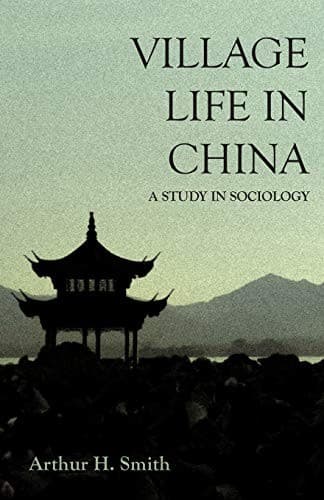
Village Life in China: A Study in SociologySmith, Arthur H.
General
Village Life in China: A Study in Sociology
Smith, Arthur H.
China -- Social life and customs; Villages
forgotten what "the small characters" (the commentary) said about them!
We have already adverted to some of the principal defects in the routine
of Chinese schools, but there is another which should not be omitted.
There is scarcely a man, woman or child in China, who will not spend a
considerable fraction of life in handling brass cash, in larger or smaller
quantities. It is a matter of great importance to each individual, to be
able to reckon, if not rapidly, at least correctly, so as to save trouble,
and what is to them of far more importance, money. It seems almost
incredible that for instruction in this most necessary of arts, there is
no provision whatever. To add, to subtract, to divide, to multiply, to
know what to do with decimal fractions, these are daily necessities of
every one in China, and yet these are things that no one teaches. Such
processes, like the art of bookkeeping in Western lands fifty years ago,
must be learned by practical experience in shops and places of business.
The village schoolmaster not only does not teach the use of the abacus, or
reckoning board, but it is by no means certain that he understands it
himself. Imagine a place in England or in the United States where the
schoolboy is taught nothing of the rules of arithmetic at school, and
where he is obliged, if he desires such knowledge, to learn the simple
rules of addition, etc., from one person, those for compound numbers from
another person, not improbably in a distant village, the measurement of
land from yet a third individual, no one of them being able to give him
all the help he requires.
The Chinese reckoning board is no doubt a very ingenious contrivance for
facilitating computation, but it is nevertheless a very clumsy one. It has
the fatal defect of leaving no trace of the processes through which the
results have been reached, so that if any mistake occurs, it is necessary
to repeat them all, on the reiterative principle of the House that Jack
Built, until the answer is, or is supposed to be correct. That all the
complicated accounts of a great commercial people like the Chinese, should
be settled only through such a medium, seems indeed singular. An expert
arrives at his conclusions with surprising celerity, but even those who
are familiar with ordinary reckoning, become puzzled the moment that a
problem is presented to them beyond the scope of the ordinary rules. If
one adult receives a pound of grain every ten days, and a child half as
much, what amount should be allotted to 227 adults and 143 children, for a
month and a half? Over a problem as simple as this, we have seen a group
of Chinese, some of whom had pretensions to classical scholarship, wrestle
for half an hour, and after all no two of them reached the same
conclusion. Indeed the greater their learning, the less fitted do the
Chinese seem to be, in a mathematical way, to struggle with their
environment.
Public-domain text, read in full here on John Shaqi.
Reviews
Reviews
No reviews yet
Be the first to share your thoughts on this work.
Elsewhere in the archive
Join the Discussion
Join the discussion
Sign in to leave a comment or review.
Sign InorCreate an account