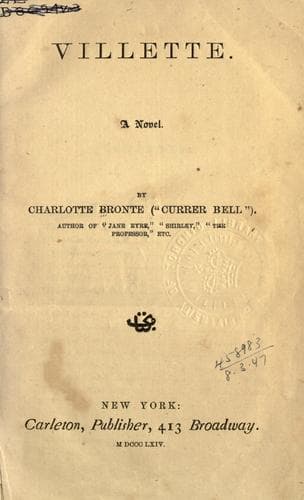
Autobiographical fiction; British -- Belgium -- Fiction; Brussels (Belgium) -- Fiction; Love stories; Women teachers -- Fiction
“Listen!” he said. “The case shall be stated, and you shall then answer
me Yes, or No; and according to your answer shall I ever after estimate
you.”
The scarce-suppressed impetus of a most irritable nature glowed in his
cheek, fed with sharp shafts his glances, a nature—the injudicious, the
mawkish, the hesitating, the sullen, the affected, above all, the
unyielding, might quickly render violent and implacable. Silence and
attention was the best balm to apply: I listened.
“The whole matter is going to fail,” he began. “Louise Vanderkelkov has
fallen ill—at least so her ridiculous mother asserts; for my part, I
feel sure she might play if she would: it is only good-will that lacks.
She was charged with a _rôle_, as you know, or do _not_ know—it is
equal: without that _rôle_ the play is stopped. There are now but a few
hours in which to learn it: not a girl in this school would hear
reason, and accept the task. Forsooth, it is not an interesting, not an
amiable, part; their vile _amour-propre_—that base quality of which
women have so much—would revolt from it. Englishwomen are either the
best or the worst of their sex. Dieu sait que je les déteste comme la
peste, ordinairement” (this between his recreant teeth). “I apply to an
Englishwoman to rescue me. What is her answer—Yes, or No?”
A thousand objections rushed into my mind. The foreign language, the
limited time, the public display… Inclination recoiled, Ability
faltered, Self-respect (that “vile quality”) trembled. “Non, non, non!”
said all these; but looking up at M. Paul, and seeing in his vexed,
fiery, and searching eye, a sort of appeal behind all its menace, my
lips dropped the word “oui”. For a moment his rigid countenance relaxed
with a quiver of content: quickly bent up again, however, he went on,—
“Vite à l’ouvrage! Here is the book; here is your _rôle_: read.” And I
read. He did not commend; at some passages he scowled and stamped. He
gave me a lesson: I diligently imitated. It was a disagreeable part—a
man’s—an empty-headed fop’s. One could put into it neither heart nor
soul: I hated it. The play—a mere trifle—ran chiefly on the efforts of
a brace of rivals to gain the hand of a fair coquette. One lover was
called the “Ours,” a good and gallant but unpolished man, a sort of
diamond in the rough; the other was a butterfly, a talker, and a
traitor: and I was to be the butterfly, talker, and traitor.
I did my best—which was bad, I know: it provoked M. Paul; he fumed.
Putting both hands to the work, I endeavoured to do better than my
best; I presume he gave me credit for good intentions; he professed to
be partially content. “Ca ira!” he cried; and as voices began sounding
from the garden, and white dresses fluttering among the trees, he
added: “You must withdraw: you must be alone to learn this. Come with
me.”
Public-domain text, read in full here on John Shaqi.
Reviews
Reviews
No reviews yet
Be the first to share your thoughts on this work.
Elsewhere in the archive
Join the Discussion
Join the discussion
Sign in to leave a comment or review.
Sign InorCreate an account