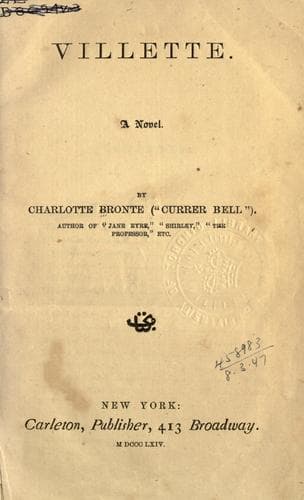
Autobiographical fiction; British -- Belgium -- Fiction; Brussels (Belgium) -- Fiction; Love stories; Women teachers -- Fiction
“Who else should it be, mamma?” demanded the Unpunctual, possessing
himself irreverently of the abdicated throne.
“Don’t you deserve cold tea, for being late?”
“I shall not get my deserts, for the urn sings cheerily.”
“Wheel yourself to the table, lazy boy: no seat will serve you but
mine; if you had one spark of a sense of propriety, you would always
leave that chair for the Old Lady.”
“So I should; only the dear Old Lady persists in leaving it for me. How
is your patient, mamma?”
“Will she come forward and speak for herself?” said Mrs. Bretton,
turning to my corner; and at this invitation, forward I came. Graham
courteously rose up to greet me. He stood tall on the hearth, a figure
justifying his mother’s unconcealed pride.
“So you are come down,” said he; “you must be better then—much better.
I scarcely expected we should meet thus, or here. I was alarmed last
night, and if I had not been forced to hurry away to a dying patient, I
certainly would not have left you; but my mother herself is something
of a doctress, and Martha an excellent nurse. I saw the case was a
fainting-fit, not necessarily dangerous. What brought it on, I have yet
to learn, and all particulars; meantime, I trust you really do feel
better?”
“Much better,” I said calmly. “Much better, I thank you, Dr. John.”
For, reader, this tall young man—this darling son—this host of
mine—this Graham Bretton, _was_ Dr. John: he, and no other; and, what
is more, I ascertained this identity scarcely with surprise. What is
more, when I heard Graham’s step on the stairs, I knew what manner of
figure would enter, and for whose aspect to prepare my eyes. The
discovery was not of to-day, its dawn had penetrated my perceptions
long since. Of course I remembered young Bretton well; and though ten
years (from sixteen to twenty-six) may greatly change the boy as they
mature him to the man, yet they could bring no such utter difference as
would suffice wholly to blind my eyes, or baffle my memory. Dr. John
Graham Bretton retained still an affinity to the youth of sixteen: he
had his eyes; he had some of his features; to wit, all the
excellently-moulded lower half of the face; I found him out soon. I
first recognised him on that occasion, noted several chapters back,
when my unguardedly-fixed attention had drawn on me the mortification
of an implied rebuke. Subsequent observation confirmed, in every point,
that early surmise. I traced in the gesture, the port, and the habits
of his manhood, all his boy’s promise. I heard in his now deep tones
the accent of former days. Certain turns of phrase, peculiar to him of
old, were peculiar to him still; and so was many a trick of eye and
lip, many a smile, many a sudden ray levelled from the irid, under his
well-charactered brow.
Public-domain text, read in full here on John Shaqi.
Reviews
Reviews
No reviews yet
Be the first to share your thoughts on this work.
Elsewhere in the archive
Join the Discussion
Join the discussion
Sign in to leave a comment or review.
Sign InorCreate an account