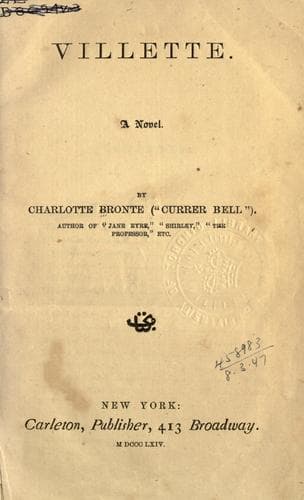
Autobiographical fiction; British -- Belgium -- Fiction; Brussels (Belgium) -- Fiction; Love stories; Women teachers -- Fiction
His mother possessed a good development of benevolence, but he owned a
better and larger. I found, on accompanying him to the Basse-Ville—the
poor and crowded quarter of the city—that his errands there were as
much those of the philanthropist as the physician. I understood
presently that cheerfully, habitually, and in single-minded
unconsciousness of any special merit distinguishing his deeds—he was
achieving, amongst a very wretched population, a world of active good.
The lower orders liked him well; his poor patients in the hospitals
welcomed him with a sort of enthusiasm.
But stop—I must not, from the faithful narrator, degenerate into the
partial eulogist. Well, full well, do I know that Dr. John was not
perfect, any more than I am perfect. Human fallibility leavened him
throughout: there was no hour, and scarcely a moment of the time I
spent with him that in act or speech, or look, he did not betray
something that was not of a god. A god could not have the cruel vanity
of Dr. John, nor his sometime levity. No immortal could have resembled
him in his occasional temporary oblivion of all but the present—in his
passing passion for that present; shown not coarsely, by devoting it to
material indulgence, but selfishly, by extracting from it whatever it
could yield of nutriment to his masculine self-love: his delight was to
feed that ravenous sentiment, without thought of the price of
provender, or care for the cost of keeping it sleek and high-pampered.
The reader is requested to note a seeming contradiction in the two
views which have been given of Graham Bretton—the public and
private—the out-door and the in-door view. In the first, the public, he
is shown oblivious of self; as modest in the display of his energies,
as earnest in their exercise. In the second, the fireside picture,
there is expressed consciousness of what he has and what he is;
pleasure in homage, some recklessness in exciting, some vanity in
receiving the same. Both portraits are correct.
It was hardly possible to oblige Dr. John quietly and in secret. When
you thought that the fabrication of some trifle dedicated to his use
had been achieved unnoticed, and that, like other men, he would use it
when placed ready for his use, and never ask whence it came, he amazed
you by a smilingly-uttered observation or two, proving that his eye had
been on the work from commencement to close: that he had noted the
design, traced its progress, and marked its completion. It pleased him
to be thus served, and he let his pleasure beam in his eye and play
about his mouth.
Public-domain text, read in full here on John Shaqi.
Reviews
Reviews
No reviews yet
Be the first to share your thoughts on this work.
Elsewhere in the archive
Join the Discussion
Join the discussion
Sign in to leave a comment or review.
Sign InorCreate an account