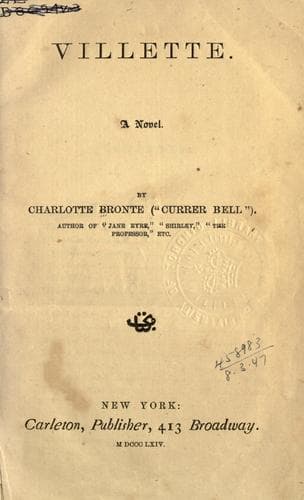
Autobiographical fiction; British -- Belgium -- Fiction; Brussels (Belgium) -- Fiction; Love stories; Women teachers -- Fiction
Yet while Dr. Bretton continued subdued, and, for him, sedate, he was
still observant. Not one of those petty impulses and natural breaks
escaped him. He did not miss one characteristic movement, one
hesitation in language, or one lisp in utterance. At times, in speaking
fast, she still lisped; but coloured whenever such lapse occurred, and
in a painstaking, conscientious manner, quite as amusing as the slight
error, repeated the word more distinctly.
Whenever she did this, Dr. Bretton smiled. Gradually, as they
conversed, the restraint on each side slackened: might the conference
have but been prolonged, I believe it would soon have become genial:
already to Paulina’s lip and cheek returned the wreathing, dimpling
smile; she lisped once, and forgot to correct herself. And Dr. John, I
know not how _he_ changed, but change he did. He did not grow gayer—no
raillery, no levity sparkled across his aspect—but his position seemed
to become one of more pleasure to himself, and he spoke his augmented
comfort in readier language, in tones more suave. Ten years ago this
pair had always found abundance to say to each other; the intervening
decade had not narrowed the experience or impoverished the intelligence
of either: besides, there are certain natures of which the mutual
influence is such, that the more they say, the more they have to say.
For these out of association grows adhesion, and out of adhesion,
amalgamation.
Graham, however, must go: his was a profession whose claims are neither
to be ignored nor deferred. He left the room; but before he could leave
the house there was a return. I am sure he came back—not for the paper,
or card in his desk, which formed his ostensible errand—but to assure
himself, by one more glance, that Paulina’s aspect was really such as
memory was bearing away: that he had not been viewing her somehow by a
partial, artificial light, and making a fond mistake. No! he found the
impression true—rather, indeed, he gained than lost by this return: he
took away with him a parting look—shy, but very soft—as beautiful, as
innocent, as any little fawn could lift out of its cover of fern, or
any lamb from its meadow-bed.
Being left alone, Paulina and I kept silence for some time: we both
took out some work, and plied a mute and diligent task. The white-wood
workbox of old days was now replaced by one inlaid with precious
mosaic, and furnished with implements of gold; the tiny and trembling
fingers that could scarce guide the needle, though tiny still, were now
swift and skilful: but there was the same busy knitting of the brow,
the same little dainty mannerisms, the same quick turns and
movements—now to replace a stray tress, and anon to shake from the
silken skirt some imaginary atom of dust—some clinging fibre of thread.
Public-domain text, read in full here on John Shaqi.
Reviews
Reviews
No reviews yet
Be the first to share your thoughts on this work.
Elsewhere in the archive
Join the Discussion
Join the discussion
Sign in to leave a comment or review.
Sign InorCreate an account