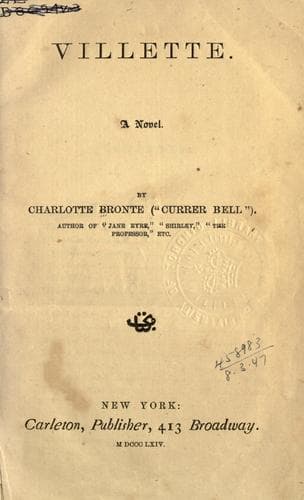
Autobiographical fiction; British -- Belgium -- Fiction; Brussels (Belgium) -- Fiction; Love stories; Women teachers -- Fiction
Well, I cleared away the ivy, and found the hole; it was large enough
to receive the jar, and I thrust it deep in. In a tool-shed at the
bottom of the garden, lay the relics of building-materials, left by
masons lately employed to repair a part of the premises. I fetched
thence a slate and some mortar, put the slate on the hollow, secured it
with cement, covered the hole with black mould, and, finally, replaced
the ivy. This done, I rested, leaning against the tree; lingering, like
any other mourner, beside a newly-sodded grave.
The air of the night was very still, but dim with a peculiar mist,
which changed the moonlight into a luminous haze. In this air, or this
mist, there was some quality—electrical, perhaps—which acted in strange
sort upon me. I felt then as I had felt a year ago in England—on a
night when the aurora borealis was streaming and sweeping round heaven,
when, belated in lonely fields, I had paused to watch that mustering of
an army with banners—that quivering of serried lances—that swift ascent
of messengers from below the north star to the dark, high keystone of
heaven’s arch. I felt, not happy, far otherwise, but strong with
reinforced strength.
If life be a war, it seemed my destiny to conduct it single-handed. I
pondered now how to break up my winter-quarters—to leave an encampment
where food and forage failed. Perhaps, to effect this change, another
pitched battle must be fought with fortune; if so, I had a mind to the
encounter: too poor to lose, God might destine me to gain. But what
road was open?—what plan available?
On this question I was still pausing, when the moon, so dim hitherto,
seemed to shine out somewhat brighter: a ray gleamed even white before
me, and a shadow became distinct and marked. I looked more narrowly, to
make out the cause of this well-defined contrast appearing a little
suddenly in the obscure alley: whiter and blacker it grew on my eye: it
took shape with instantaneous transformation. I stood about three yards
from a tall, sable-robed, snowy-veiled woman.
Five minutes passed. I neither fled nor shrieked. She was there still.
I spoke.
“Who are you? and why do you come to me?”
She stood mute. She had no face—no features: all below her brow was
masked with a white cloth; but she had eyes, and they viewed me.
I felt, if not brave, yet a little desperate; and desperation will
often suffice to fill the post and do the work of courage. I advanced
one step. I stretched out my hand, for I meant to touch her. She seemed
to recede. I drew nearer: her recession, still silent, became swift. A
mass of shrubs, full-leaved evergreens, laurel and dense yew,
intervened between me and what I followed. Having passed that obstacle,
I looked and saw nothing. I waited. I said,—“If you have any errand to
men, come back and deliver it.” Nothing spoke or re-appeared.
This time there was no Dr. John to whom to have recourse: there was no
one to whom I dared whisper the words, “I have again seen the nun.”
Public-domain text, read in full here on John Shaqi.
Reviews
Reviews
No reviews yet
Be the first to share your thoughts on this work.
Elsewhere in the archive
Join the Discussion
Join the discussion
Sign in to leave a comment or review.
Sign InorCreate an account