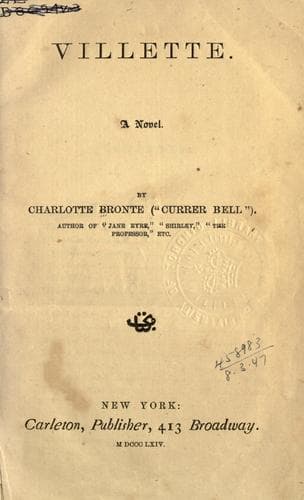
Autobiographical fiction; British -- Belgium -- Fiction; Brussels (Belgium) -- Fiction; Love stories; Women teachers -- Fiction
“Do—_do_ tell me who you are? I’ll not repeat it,” she urged, adhering
with ludicrous tenacity to the wise notion of an incognito she had got
hold of; and she squeezed the arm of which she had now obtained full
possession, and coaxed and conjured till I was obliged to pause in the
park to laugh. Throughout our walk she rang the most fanciful changes
on this theme; proving, by her obstinate credulity, or incredulity, her
incapacity to conceive how any person not bolstered up by birth or
wealth, not supported by some consciousness of name or connection,
could maintain an attitude of reasonable integrity. As for me, it quite
sufficed to my mental tranquillity that I was known where it imported
that known I should be; the rest sat on me easily: pedigree, social
position, and recondite intellectual acquisition, occupied about the
same space and place in my interests and thoughts; they were my
third-class lodgers—to whom could be assigned only the small
sitting-room and the little back bedroom: even if the dining and
drawing-rooms stood empty, I never confessed it to them, as thinking
minor accommodations better suited to their circumstances. The world, I
soon learned, held a different estimate: and I make no doubt, the world
is very right in its view, yet believe also that I am not quite wrong
in mine.
There are people whom a lowered position degrades morally, to whom loss
of connection costs loss of self-respect: are not these justified in
placing the highest value on that station and association which is
their safeguard from debasement? If a man feels that he would become
contemptible in his own eyes were it generally known that his ancestry
were simple and not gentle, poor and not rich, workers and not
capitalists, would it be right severely to blame him for keeping these
fatal facts out of sight—for starting, trembling, quailing at the
chance which threatens exposure? The longer we live, the more our
experience widens; the less prone are we to judge our neighbour’s
conduct, to question the world’s wisdom: wherever an accumulation of
small defences is found, whether surrounding the prude’s virtue or the
man of the world’s respectability, there, be sure, it is needed.
We reached the Hôtel Crécy; Paulina was ready; Mrs. Bretton was with
her; and, under her escort and that of M. de Bassompierre, we were soon
conducted to the place of assembly, and seated in good seats, at a
convenient distance from the Tribune. The youth of the Athénée were
marshalled before us, the municipality and their bourgmestre were in
places of honour, the young princes, with their tutors, occupied a
conspicuous position, and the body of the building was crowded with the
aristocracy and first burghers of the town.
Public-domain text, read in full here on John Shaqi.
Reviews
Reviews
No reviews yet
Be the first to share your thoughts on this work.
Elsewhere in the archive
Join the Discussion
Join the discussion
Sign in to leave a comment or review.
Sign InorCreate an account