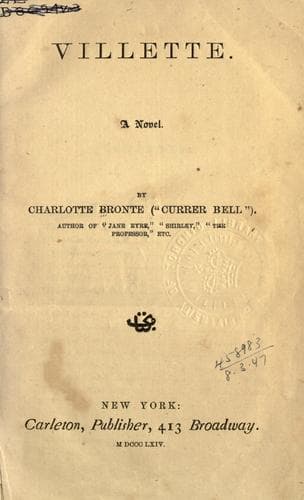
Autobiographical fiction; British -- Belgium -- Fiction; Brussels (Belgium) -- Fiction; Love stories; Women teachers -- Fiction
While Dr. Bretton listened, and waited an opening in the magic circle,
his glance restlessly sweeping the room at intervals, lighted by chance
on me, where I sat in a quiet nook not far from my godmother and M. de
Bassompierre, who, as usual, were engaged in what Mr. Home called “a
two-handed crack:” what the Count would have interpreted as a
tête-à-tête. Graham smiled recognition, crossed the room, asked me how
I was, told me I looked pale. I also had my own smile at my own
thought: it was now about three months since Dr. John had spoken to
me—a lapse of which he was not even conscious. He sat down, and became
silent. His wish was rather to look than converse. Ginevra and Paulina
were now opposite to him: he could gaze his fill: he surveyed both
forms—studied both faces.
Several new guests, ladies as well as gentlemen, had entered the room
since dinner, dropping in for the evening conversation; and amongst the
gentlemen, I may incidentally observe, I had already noticed by
glimpses, a severe, dark, professorial outline, hovering aloof in an
inner saloon, seen only in vista. M. Emanuel knew many of the gentlemen
present, but I think was a stranger to most of the ladies, excepting
myself; in looking towards the hearth, he could not but see me, and
naturally made a movement to approach; seeing, however, Dr. Bretton
also, he changed his mind and held back. If that had been all, there
would have been no cause for quarrel; but not satisfied with holding
back, he puckered up his eyebrows, protruded his lip, and looked so
ugly that I averted my eyes from the displeasing spectacle. M. Joseph
Emanuel had arrived, as well as his austere brother, and at this very
moment was relieving Ginevra at the piano. What a master-touch
succeeded her school-girl jingle! In what grand, grateful tones the
instrument acknowledged the hand of the true artist!
“Lucy,” began Dr. Bretton, breaking silence and smiling, as Ginevra
glided before him, casting a glance as she passed by, “Miss Fanshawe is
certainly a fine girl.”
Of course I assented.
“Is there,” he pursued, “another in the room as lovely?”
“I think there is not another as handsome.”
“I agree with you, Lucy: you and I do often agree in opinion, in taste,
I think; or at least in judgment.”
“Do we?” I said, somewhat doubtfully.
“I believe if you had been a boy, Lucy, instead of a girl—my mother’s
god-son instead of her god-daughter, we should have been good friends:
our opinions would have melted into each other.”
Public-domain text, read in full here on John Shaqi.
Reviews
Reviews
No reviews yet
Be the first to share your thoughts on this work.
Elsewhere in the archive
Join the Discussion
Join the discussion
Sign in to leave a comment or review.
Sign InorCreate an account