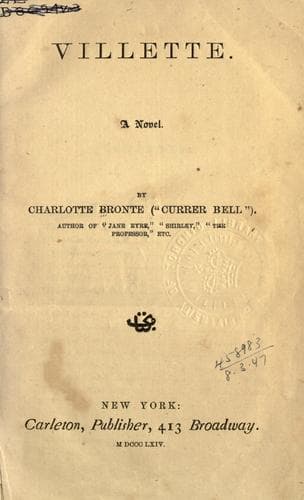
Autobiographical fiction; British -- Belgium -- Fiction; Brussels (Belgium) -- Fiction; Love stories; Women teachers -- Fiction
hiding-place the last lurking thought of the heart, and discerned under
florid veilings the bare; barren places of the spirit: yes, and its
perverted tendencies, and its hidden false curves—all that men and
women would not have known—the twisted spine, the malformed limb that
was born with them, and far worse, the stain or disfigurement they have
perhaps brought on themselves. No calamity so accursed but M. Emanuel
could pity and forgive, if it were acknowledged candidly; but where his
questioning eyes met dishonest denial—where his ruthless researches
found deceitful concealment—oh, then, he could be cruel, and I thought
wicked! he would exultantly snatch the screen from poor shrinking
wretches, passionately hurry them to the summit of the mount of
exposure, and there show them all naked, all false—poor living lies—the
spawn of that horrid Truth which cannot be looked on unveiled. He
thought he did justice; for my part I doubt whether man has a right to
do such justice on man: more than once in these his visitations, I have
felt compelled to give tears to his victims, and not spared ire and
keen reproach to himself. He deserved it; but it was difficult to shake
him in his firm conviction that the work was righteous and needed.
Breakfast being over and mass attended, the school-bell rang and the
rooms filled: a very pretty spectacle was presented in classe. Pupils
and teachers sat neatly arrayed, orderly and expectant, each bearing in
her hand the bouquet of felicitation—the prettiest spring-flowers all
fresh, and filling the air with their fragrance: I only had no bouquet.
I like to see flowers growing, but when they are gathered, they cease
to please. I look on them as things rootless and perishable; their
likeness to life makes me sad. I never offer flowers to those I love; I
never wish to receive them from hands dear to me. Mademoiselle St.
Pierre marked my empty hands—she could not believe I had been so
remiss; with avidity her eye roved over and round me: surely I must
have some solitary symbolic flower somewhere: some small knot of
violets, something to win myself praise for taste, commendation for
ingenuity. The unimaginative “Anglaise” proved better than the
Parisienne’s fears: she sat literally unprovided, as bare of bloom or
leaf as the winter tree. This ascertained, Zélie smiled, well pleased.
“How wisely you have acted to keep your money, Miss Lucie,” she said:
“silly I have gone and thrown away two francs on a bouquet of hot-house
flowers!”
And she showed with pride her splendid nosegay.
But hush! a step: _the_ step. It came prompt, as usual, but with a
promptitude, we felt disposed to flatter ourselves, inspired by other
feelings than mere excitability of nerve and vehemence of intent. We
thought our Professor’s “foot-fall” (to speak romantically) had in it a
friendly promise this morning; and so it had.
Public-domain text, read in full here on John Shaqi.
Reviews
Reviews
No reviews yet
Be the first to share your thoughts on this work.
Elsewhere in the archive
Join the Discussion
Join the discussion
Sign in to leave a comment or review.
Sign InorCreate an account