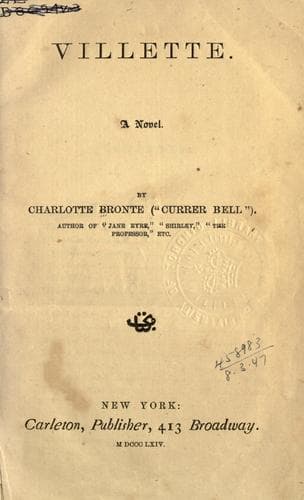
Autobiographical fiction; British -- Belgium -- Fiction; Brussels (Belgium) -- Fiction; Love stories; Women teachers -- Fiction
Three months afterwards, hearing that his vanquished foe had met with
reverses, and was likely to be really distressed for want of
employment, he forgot his hatred, and alike active in good and evil, he
moved heaven and earth till he found her a place. Upon her coming to
make up former differences, and thank him for his recent kindness, the
old voice—a little loud—the old manner—a little forward—so acted upon
him that in ten minutes he started up and bowed her, or rather himself,
out of the room, in a transport of nervous irritation.
To pursue a somewhat audacious parallel, in a love of power, in an
eager grasp after supremacy, M. Emanuel was like Bonaparte. He was a
man not always to be submitted to. Sometimes it was needful to resist;
it was right to stand still, to look up into his eyes and tell him that
his requirements went beyond reason—that his absolutism verged on
tyranny.
The dawnings, the first developments of peculiar talent appearing
within his range, and under his rule, curiously excited, even disturbed
him. He watched its struggle into life with a scowl; he held back his
hand—perhaps said, “Come on if you have strength,” but would not aid
the birth.
When the pang and peril of the first conflict were over, when the
breath of life was drawn, when he saw the lungs expand and contract,
when he felt the heart beat and discovered life in the eye, he did not
yet offer to foster.
“Prove yourself true ere I cherish you,” was his ordinance; and how
difficult he made that proof! What thorns and briers, what flints, he
strewed in the path of feet not inured to rough travel! He watched
tearlessly—ordeals that he exacted should be passed through—fearlessly.
He followed footprints that, as they approached the bourne, were
sometimes marked in blood—followed them grimly, holding the austerest
police-watch over the pain-pressed pilgrim. And when at last he allowed
a rest, before slumber might close the eyelids, he opened those same
lids wide, with pitiless finger and thumb, and gazed deep through the
pupil and the irids into the brain, into the heart, to search if
Vanity, or Pride, or Falsehood, in any of its subtlest forms, was
discoverable in the furthest recess of existence. If, at last, he let
the neophyte sleep, it was but a moment; he woke him suddenly up to
apply new tests: he sent him on irksome errands when he was staggering
with weariness; he tried the temper, the sense, and the health; and it
was only when every severest test had been applied and endured, when
the most corrosive aquafortis had been used, and failed to tarnish the
ore, that he admitted it genuine, and, still in clouded silence,
stamped it with his deep brand of approval.
I speak not ignorant of these evils.
Public-domain text, read in full here on John Shaqi.
Reviews
Reviews
No reviews yet
Be the first to share your thoughts on this work.
Elsewhere in the archive
Join the Discussion
Join the discussion
Sign in to leave a comment or review.
Sign InorCreate an account