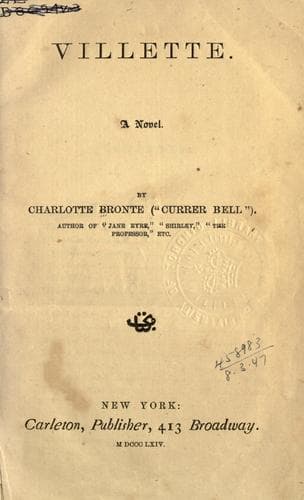
Autobiographical fiction; British -- Belgium -- Fiction; Brussels (Belgium) -- Fiction; Love stories; Women teachers -- Fiction
The combat was very sharp for a time. I seemed to have lost M. Paul’s
affection; he treated me strangely. In his most unjust moments he would
insinuate that I had deceived him when I appeared, what he called
“faible”—that is incompetent; he said I had feigned a false incapacity.
Again, he would turn suddenly round and accuse me of the most
far-fetched imitations and impossible plagiarisms, asserting that I had
extracted the pith out of books I had not so much as heard of—and over
the perusal of which I should infallibly have fallen down in a sleep as
deep as that of Eutychus.
Once, upon his preferring such an accusation, I turned upon him—I rose
against him. Gathering an armful of his books out of my desk, I filled
my apron and poured them in a heap upon his estrade, at his feet.
“Take them away, M. Paul,” I said, “and teach me no more. I never asked
to be made learned, and you compel me to feel very profoundly that
learning is not happiness.”
And returning to my desk, I laid my head on my arms, nor would I speak
to him for two days afterwards. He pained and chagrined me. His
affection had been very sweet and dear—a pleasure new and incomparable:
now that this seemed withdrawn, I cared not for his lessons.
The books, however, were not taken away; they were all restored with
careful hand to their places, and he came as usual to teach me. He made
his peace somehow—too readily, perhaps: I ought to have stood out
longer, but when he looked kind and good, and held out his hand with
amity, memory refused to reproduce with due force his oppressive
moments. And then, reconcilement is always sweet!
On a certain morning a message came from my godmother, inviting me to
attend some notable lecture to be delivered in the same public rooms
before described. Dr. John had brought the message himself, and
delivered it verbally to Rosine, who had not scrupled to follow the
steps of M. Emanuel, then passing to the first classe, and, in his
presence, stand “carrément” before my desk, hand in apron-pocket, and
rehearse the same, saucily and aloud, concluding with the words, “Qu’il
est vraiment beau, Mademoiselle, ce jeune docteur! Quels yeux—quel
regard! Tenez! J’en ai le cœur tout ému!”
When she was gone, my professor demanded of me why I suffered “cette
fille effrontée, cette créature sans pudeur,” to address me in such
terms.
I had no pacifying answer to give. The terms were precisely such as
Rosine—a young lady in whose skull the organs of reverence and reserve
were not largely developed—was in the constant habit of using. Besides,
what she said about the young doctor was true enough. Graham _was_
handsome; he had fine eyes and a thrilling glance. An observation to
that effect actually formed itself into sound on my lips.
“Elle ne dit que la vérité,” I said.
“Ah! vous trouvez?”
“Mais, sans doute.”
Public-domain text, read in full here on John Shaqi.
Reviews
Reviews
No reviews yet
Be the first to share your thoughts on this work.
Elsewhere in the archive
Join the Discussion
Join the discussion
Sign in to leave a comment or review.
Sign InorCreate an account