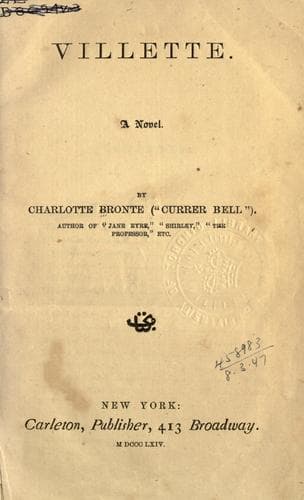
Autobiographical fiction; British -- Belgium -- Fiction; Brussels (Belgium) -- Fiction; Love stories; Women teachers -- Fiction
The morrow made me further acquainted with Mrs. Sweeny. It seems she
had introduced herself to her present employer as an English lady in
reduced circumstances: a native, indeed, of Middlesex, professing to
speak the English tongue with the purest metropolitan accent.
Madame—reliant on her own infallible expedients for finding out the
truth in time—had a singular intrepidity in hiring service off-hand (as
indeed seemed abundantly proved in my own case). She received Mrs.
Sweeny as nursery-governess to her three children. I need hardly
explain to the reader that this lady was in effect a native of Ireland;
her station I do not pretend to fix: she boldly declared that she had
“had the bringing-up of the son and daughter of a marquis.” I think
myself, she might possibly have been a hanger-on, nurse, fosterer, or
washerwoman, in some Irish family: she spoke a smothered tongue,
curiously overlaid with mincing cockney inflections. By some means or
other she had acquired, and now held in possession, a wardrobe of
rather suspicious splendour—gowns of stiff and costly silk, fitting her
indifferently, and apparently made for other proportions than those
they now adorned; caps with real lace borders, and—the chief item in
the inventory, the spell by which she struck a certain awe through the
household, quelling the otherwise scornfully disposed teachers and
servants, and, so long as her broad shoulders _wore_ the folds of that
majestic drapery, even influencing Madame herself—_a real Indian
shawl_—“un véritable cachemire,” as Madame Beck said, with unmixed
reverence and amaze. I feel quite sure that without this “cachemire”
she would not have kept her footing in the pensionnat for two days: by
virtue of it, and it only, she maintained the same a month.
But when Mrs. Sweeny knew that I was come to fill her shoes, then it
was that she declared herself—then did she rise on Madame Beck in her
full power—then come down on me with her concentrated weight. Madame
bore this revelation and visitation so well, so stoically, that I for
very shame could not support it otherwise than with composure. For one
little moment Madame Beck absented herself from the room; ten minutes
after, an agent of the police stood in the midst of us. Mrs. Sweeny and
her effects were removed. Madame’s brow had not been ruffled during the
scene—her lips had not dropped one sharply-accented word.
This brisk little affair of the dismissal was all settled before
breakfast: order to march given, policeman called, mutineer expelled;
“chambre d’enfans” fumigated and cleansed, windows thrown open, and
every trace of the accomplished Mrs. Sweeny—even to the fine essence
and spiritual fragrance which gave token so subtle and so fatal of the
head and front of her offending—was annihilated from the Rue Fossette:
all this, I say, was done between the moment of Madame Beck’s issuing
like Aurora from her chamber, and that in which she coolly sat down to
pour out her first cup of coffee.
Public-domain text, read in full here on John Shaqi.
Reviews
Reviews
No reviews yet
Be the first to share your thoughts on this work.
Join the Discussion
Join the discussion
Sign in to leave a comment or review.
Sign InorCreate an account