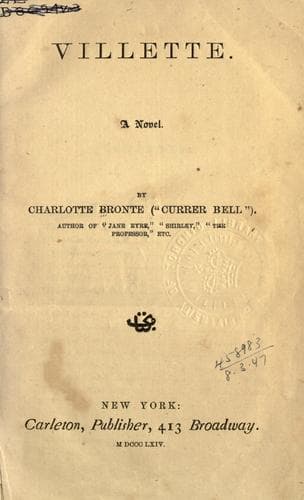
Autobiographical fiction; British -- Belgium -- Fiction; Brussels (Belgium) -- Fiction; Love stories; Women teachers -- Fiction
Nor would he ever have found this out, but that one day, while he sat
in the sunshine and I was observing the colouring of his hair,
whiskers, and complexion—the whole being of such a tone as a strong
light brings out with somewhat perilous force (indeed I recollect I was
driven to compare his beamy head in my thoughts to that of the “golden
image” which Nebuchadnezzar the king had set up), an idea new, sudden,
and startling, riveted my attention with an over-mastering strength and
power of attraction. I know not to this day how I looked at him: the
force of surprise, and also of conviction, made me forget myself; and I
only recovered wonted consciousness when I saw that his notice was
arrested, and that it had caught my movement in a clear little oval
mirror fixed in the side of the window recess—by the aid of which
reflector Madame often secretly spied persons walking in the garden
below. Though of so gay and sanguine a temperament, he was not without
a certain nervous sensitiveness which made him ill at ease under a
direct, inquiring gaze. On surprising me thus, he turned and said, in a
tone which, though courteous, had just so much dryness in it as to mark
a shade of annoyance, as well as to give to what was said the character
of rebuke, “Mademoiselle does not spare me: I am not vain enough to
fancy that it is my merits which attract her attention; it must then be
some defect. Dare I ask—what?”
I was confounded, as the reader may suppose, yet not with an
irrecoverable confusion; being conscious that it was from no emotion of
incautious admiration, nor yet in a spirit of unjustifiable
inquisitiveness, that I had incurred this reproof. I might have cleared
myself on the spot, but would not. I did not speak. I was not in the
habit of speaking to him. Suffering him, then, to think what he chose
and accuse me of what he would, I resumed some work I had dropped, and
kept my head bent over it during the remainder of his stay. There is a
perverse mood of the mind which is rather soothed than irritated by
misconstruction; and in quarters where we can never be rightly known,
we take pleasure, I think, in being consummately ignored. What honest
man, on being casually taken for a housebreaker, does not feel rather
tickled than vexed at the mistake?
CHAPTER XI.
THE PORTRESS’S CABINET.
Public-domain text, read in full here on John Shaqi.
Reviews
Reviews
No reviews yet
Be the first to share your thoughts on this work.
Elsewhere in the archive
Join the Discussion
Join the discussion
Sign in to leave a comment or review.
Sign InorCreate an account