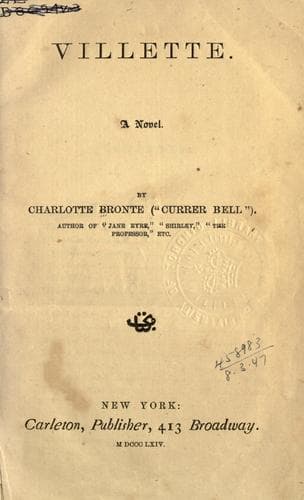
Autobiographical fiction; British -- Belgium -- Fiction; Brussels (Belgium) -- Fiction; Love stories; Women teachers -- Fiction
Meanwhile, as I pondered, I knew I must go in. Lights, moving in the
dormitory, announced that prayers were over, and the pupils going to
bed. Another half-hour and all doors would be locked—all lights
extinguished. The front door yet stood open, to admit into the heated
house the coolness of the summer night; from the portress’s cabinet
close by shone a lamp, showing the long vestibule with the two-leaved
drawing-room doors on one side, the great street-door closing the
vista.
All at once, quick rang the bell—quick, but not loud—a cautious
tinkle—a sort of warning metal whisper. Rosine darted from her cabinet
and ran to open. The person she admitted stood with her two minutes in
parley: there seemed a demur, a delay. Rosine came to the garden door,
lamp in hand; she stood on the steps, lifting her lamp, looking round
vaguely.
“Quel conte!” she cried, with a coquettish laugh. “Personne n’y a été.”
“Let me pass,” pleaded a voice I knew: “I ask but five minutes;” and a
familiar shape, tall and grand (as we of the Rue Fossette all thought
it), issued from the house, and strode down amongst the beds and walks.
It was sacrilege—the intrusion of a man into that spot, at that hour;
but he knew himself privileged, and perhaps he trusted to the friendly
night. He wandered down the alleys, looking on this side and on that—he
was lost in the shrubs, trampling flowers and breaking branches in his
search—he penetrated at last the “forbidden walk.” There I met him,
like some ghost, I suppose.
“Dr. John! it is found.”
He did not ask by whom, for with his quick eye he perceived that I held
it in my hand.
“Do not betray her,” he said, looking at me as if I were indeed a
dragon.
“Were I ever so disposed to treachery, I cannot betray what I do not
know,” was my answer. “Read the note, and you will see how little it
reveals.”
“Perhaps you have read it,” I thought to myself; and yet I could not
believe he wrote it: that could hardly be his style: besides, I was
fool enough to think there would be a degree of hardship in his calling
me such names. His own look vindicated him; he grew hot, and coloured
as he read.
“This is indeed too much: this is cruel, this is humiliating,” were the
words that fell from him.
I thought it _was_ cruel, when I saw his countenance so moved. No
matter whether he was to blame or not; somebody, it seemed to me, must
be more to blame.
“What shall you do about it?” he inquired of me. “Shall you tell Madame
Beck what you have found, and cause a stir—an esclandre?”
I thought I ought to tell, and said so; adding that I did not believe
there would be either stir or esclandre: Madame was much too prudent to
make a noise about an affair of that sort connected with her
establishment.
Public-domain text, read in full here on John Shaqi.
Reviews
Reviews
No reviews yet
Be the first to share your thoughts on this work.
Elsewhere in the archive
Join the Discussion
Join the discussion
Sign in to leave a comment or review.
Sign InorCreate an account