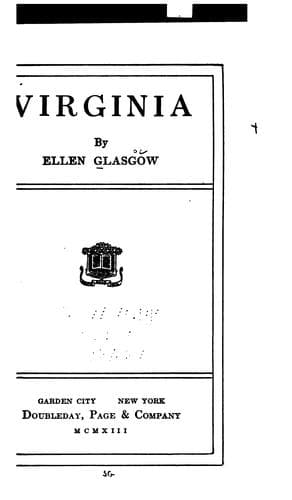
Marriage -- Fiction; Virginia -- Fiction; Wives -- Fiction; Women -- Fiction
"But I can't go to bed until you do, darling. I get so worried about
you," she answered.
"Why in heaven's name, should you worry about me? I am all right," he
responded crossly.
She saw her mistake, and with her unvarying sweetness, set out to
rectify it.
"Of course, I know you are--but we have so little time together that I
don't want to miss the evenings."
"So little!" he echoed, not unkindly, but in simple astonishment.
"I mean the children sit up late now, and of course we can't talk while
they are playing in the room."
"Don't you think you might get them to bed earlier? They are becoming
rather a nuisance, aren't they?"
He said it kindly enough, yet tears rushed to her eyes as she looked at
him. It was impossible for her to conceive of any mood in which the
children would become "rather a nuisance" to her, and the words hurt her
more than he was ever to know. It seemed the last straw that she could
not bear, said her heart as she turned away from him. She had borne the
extra work without a complaint; she had pinched and scraped, if not
happily, at least with a smile; she had sat up while her limbs ached
with fatigue and the longing to be in bed--and all these things were as
nothing to the tragic confession that the children had become "rather a
nuisance." Of the many trials she had had to endure, this, she told
herself, was the bitterest.
Though her feet burned and her muscles throbbed with fatigue, she lay
awake for hours, with her eyes wide open in the moonlight. All the small
harassing duties of the morrow, which usually swarmed like startled bees
through her brain at night, were scattered now by this vague terror
which assumed no definite shape. The delicacy of Lucy's chest, Harry's
stubborn refusal to learn to spell, and even the harrowing certainty
that the children's appetites were fast outstripping the frugal fare she
provided--these stinging worries had flown before a new anxiety which
was the more poignant, she felt, because she could not give it a name.
The Pendleton idealism was powerless to dispel this malign shadow which
corresponded so closely to that substance of evil whose very existence
the Pendleton idealism eternally denied. To battle with a delusion was
virtually to admit one's belief in its actuality, and this, she
reflected passionately, lying awake there in the darkness, was the last
thing she was prepared at the moment to do. Oliver was changed, and yet
her duty was plainly to fortify herself with the consoling assurance
that, whatever happened, Oliver could never really change. Deep down in
her that essential fibre of her being which was her soul--which drew its
vitality from the racial structure of which it was a part, and yet which
distinguished and separated her from every other person and object in
the universe--this essential fibre was compacted of innumerable
Pendleton refusals to face the reality. Even with Lucy's chest and
Harry's lessons and the cost of food, she had always felt a soothing
Public-domain text, read in full here on John Shaqi.
Reviews
Reviews
No reviews yet
Be the first to share your thoughts on this work.
Elsewhere in the archive
Join the Discussion
Join the discussion
Sign in to leave a comment or review.
Sign InorCreate an account